
The search for the best restaurant operations platforms for growing businesses is about much more than point-of-sale. Modern restaurants run on data, automation, and seamless workflows that connect ordering, payments, kitchen production, inventory, labor, delivery, and guest engagement.
When you’re scaling from one location to many—or from a pop-up to a multi-concept group—you need a flexible backbone that standardizes operations without killing creativity.
In this guide, we’ll unpack what a true restaurant operations platform is, how to evaluate vendors, which stacks work best by concept, how to implement successfully, and which metrics matter.
Throughout, we’ll keep a sharp focus on the needs of growing businesses—where budget, speed, and reliability collide with real-world complexity.
If you’re shopping for the best restaurant operations platforms for growing businesses, use this as a practical, updated playbook to save time, avoid costly missteps, and build a foundation that scales.
What is a Restaurant Operations Platform?
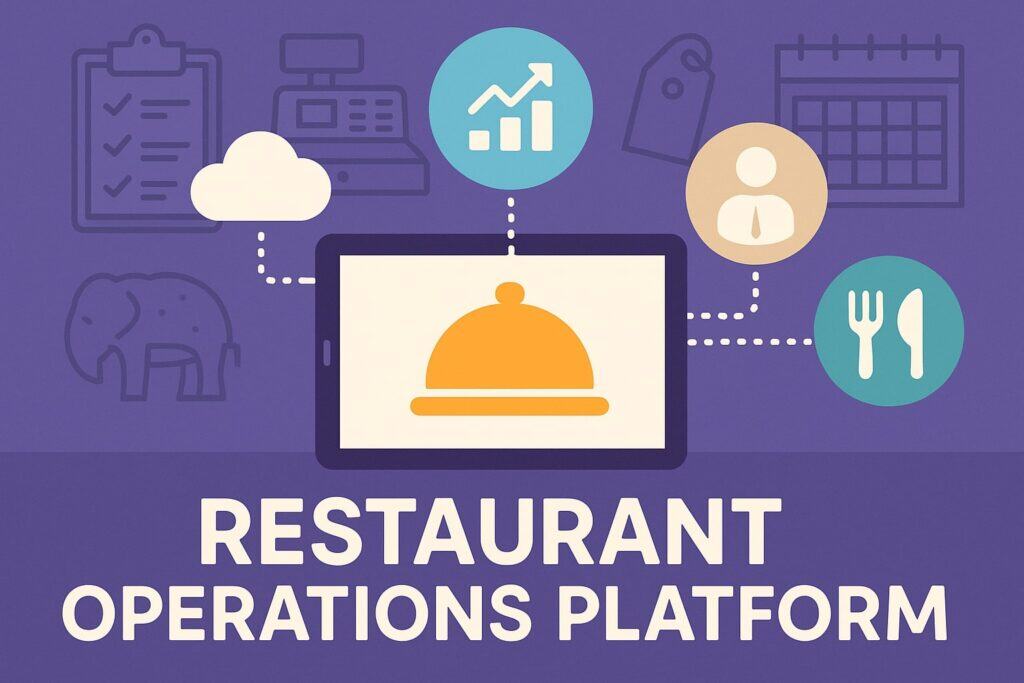
A restaurant operations platform is an integrated software ecosystem that unifies your front-of-house, back-of-house, and off-premise channels into one operational truth.
It typically anchors around a restaurant-grade POS but extends to kitchen display systems (KDS), menu management, order aggregation, inventory and food costing, labor scheduling, payroll integrations, loyalty and CRM, analytics, and payments.
The best restaurant operations platforms for growing businesses reduce swivel-chair work—copying data between apps, reconciling menus for each marketplace, re-entering prep lists—and replacing it with automated, standardized workflows.
They provide real-time visibility into sales, covers, check averages, item-level margins, theoretical vs. actual food cost, labor variance, voids and comps, and channel mix (dine-in, pickup, delivery, catering).
Crucially, a platform is extensible. You can start lean—say, POS + KDS + payments—and add modules like inventory, accounting, or guest engagement as you scale.
The most capable solutions are API-first, meaning they connect easily with delivery aggregators, reservation systems, feedback tools, accounting suites, and digital experience layers like kiosks or QR ordering.
For operators, this turns many moving parts into a single control plane for menus, modifiers, pricing, taxes, fees, and 86ing. For finance, it creates a trustworthy data pipeline from transaction to general ledger.
For marketing, it transforms disparate guest touchpoints into a cohesive understanding of lifetime value. If you want the best restaurant operations platforms for growing businesses, prioritize platforms that centralize data, standardize processes, and still let you innovate at the edge.
How to Evaluate the Best Restaurant Operations Platforms for Growing Businesses
Evaluating the best restaurant operations platforms for growing businesses requires a lens that balances today’s needs with tomorrow’s ambitions. Start with fit for concept: QSR, fast-casual, full-service, bar-centric, food hall, or ghost kitchen all have distinct requirements for speed, menu complexity, and service models.
Then consider the growth path: how many units in 12–24 months? Multi-brand under one roof? Franchising? Platforms that handle multi-location menu versioning, regional tax rules, and centralized item libraries will save immense time.
Look for operational resilience: offline mode that still takes orders and payments during internet drops; hardware that survives heat and grease; and KDS logic that adapts to course-fire rules or make-line routing.
Next, assess total cost of ownership (TCO). The best restaurant operations platforms for growing businesses might cost more upfront but reduce labor waste, stockouts, refunds, and 3rd-party reconciliation effort.
Model software subscriptions, payment processing rates, hardware, implementation, training, support tiers, and future modules you’ll likely add. Scrutinize data portability and open APIs—you’ll want to avoid being trapped in a walled garden.
Finally, judge time-to-value: how quickly can your team go live, roll out menu changes, onboard new hires, adopt inventory counts, and act on analytics? Ask for proof: reference customers, documented uptime, and sample dashboards.
Great platforms feel invisible during a rush—and indispensable when you analyze yesterday’s performance at 7 a.m.
Scalability & Multi-Location Control
Scalability is the beating heart of the best restaurant operations platforms for growing businesses. As you expand, the platform must support centralized control with local flexibility.
That means a single source of truth for items, modifiers, pricing rules, taxes, fees, and discounts—while allowing unit-level exceptions like local specials or regional price rolls. Menu versioning should let you test price elasticity in one market without breaking another.
For multi-brand operators, shared item libraries and cross-brand reporting are critical to reduce duplication and to compare performance apples-to-apples.
Operational scalability also includes peak-load tolerance. Black Friday delivery surges, holiday catering, or a viral TikTok dish shouldn’t bring your system to its knees. Look for serverless or autoscaling architectures, robust offline caching, and KDS that distribute make tickets across multiple stations.
Consider user management at scale with role-based access controls (RBAC), SSO, and audit logs so you can onboard, transfer, or offboard staff quickly.
The best restaurant operations platforms for growing businesses also streamline multi-location inventory with centralized vendor catalogs, order guides, and par levels, while allowing flexible receiving and transfer flows. When scalability is native, new-store openings become repeatable checklists, not experimental rebuilds.
Open APIs & Integration Ecosystem
No single vendor does everything perfectly. The best restaurant operations platforms for growing businesses acknowledge this by providing well-documented open APIs, event webhooks, and certified app marketplaces.
This lets you plug in reservations, table management, waitlists, guest feedback, delivery aggregators, kiosk vendors, digital signage, tip management, HR/payroll, accounting (e.g., QuickBooks, Xero, Sage, NetSuite), and data warehouses (BigQuery, Snowflake, Redshift).
API maturity matters: look for item-level CRUD, order ingestion, payment events, menu push/pull, inventory endpoints, and analytics exports. Webhooks for order updates, voids, refunds, and 86 events keep downstream apps in sync without polling.
Integration isn’t just a checkbox—it’s an operational strategy. With the right ecosystem, you can build a best-of-breed stack around the core platform while maintaining a seamless employee and guest experience.
For example, an operator might run POS + KDS + payments from the platform, layer on third-party reservations and loyalty, pipe data to a warehouse, and automate nightly journal entries into accounting.
The best restaurant operations platforms for growing businesses make this easy with sandbox environments, API rate limits that support real use, and integration partners who know restaurants. You’re not just buying features—you’re buying optionality.
Total Cost of Ownership & ROI
Sticker price rarely tells the whole story. When comparing the best restaurant operations platforms for growing businesses, build a TCO model over 36 months.
Include software subscriptions, payment processing (effective blended rate after card mix, chargebacks, and disputes), hardware replacement cycles, implementation and training, premium support, and the cost of necessary third-party apps.
Then quantify operational gains: reduced order errors from KDS, fewer comps/voids via manager approvals, lower food cost from accurate counts and vendor price audits, lower labor variance with forecasting and schedule adherence, and faster month-end with automated accounting exports.
ROI also shows up in revenue lift: faster service times, better order throttling for delivery, improved online menu conversion, personalized offers that raise repeat visit frequency, and smarter product mix decisions.
The best restaurant operations platforms for growing businesses surface these gains in built-in analytics and make it easy to run A/B tests (e.g., price or modifier changes). Don’t ignore risk costs: platforms with poor uptime, weak support, or slow menu publishing can cause missed sales and angry guests.
Finally, negotiate pricing transparency: avoid teaser rates that jump on renewal, insist on clear payment terms, and lock in processing margins where possible. A platform that measurably improves contribution margin is worth more than a cheaper one that doesn’t.
Usability, Training & Change Management
Technology fails when humans can’t or won’t use it. The best restaurant operations platforms for growing businesses prioritize usability at every station: cashiers, servers, bartenders, expo, kitchen, and managers.
Touch flows should minimize taps for common orders, support conversational ordering, and handle complex modifiers without confusion.
KDS screens must be readable at a glance, with color-coded statuses, routing rules, and bump bars that work with gloved or messy hands. Manager tools should simplify 86ing, comping, price changes, and employee permissions.
Training is equally important. Seek platforms with role-based training, embedded tooltips, quick-hit videos, and a sandbox mode for practice.
Strong remote menu management lets your central team make changes once and deploy everywhere, avoiding each store “doing its own thing.” Plan for change management: designate super-users, set cut-over dates, run parallel systems only when necessary, and celebrate quick wins (like reduced ticket times).
Reliable support with restaurant-hours coverage (evenings, weekends) is non-negotiable. Ultimately, the best restaurant operations platforms for growing businesses fade into the background in service, then shine post-shift when leaders review performance and plan improvements.
Platform Capabilities That Matter Most
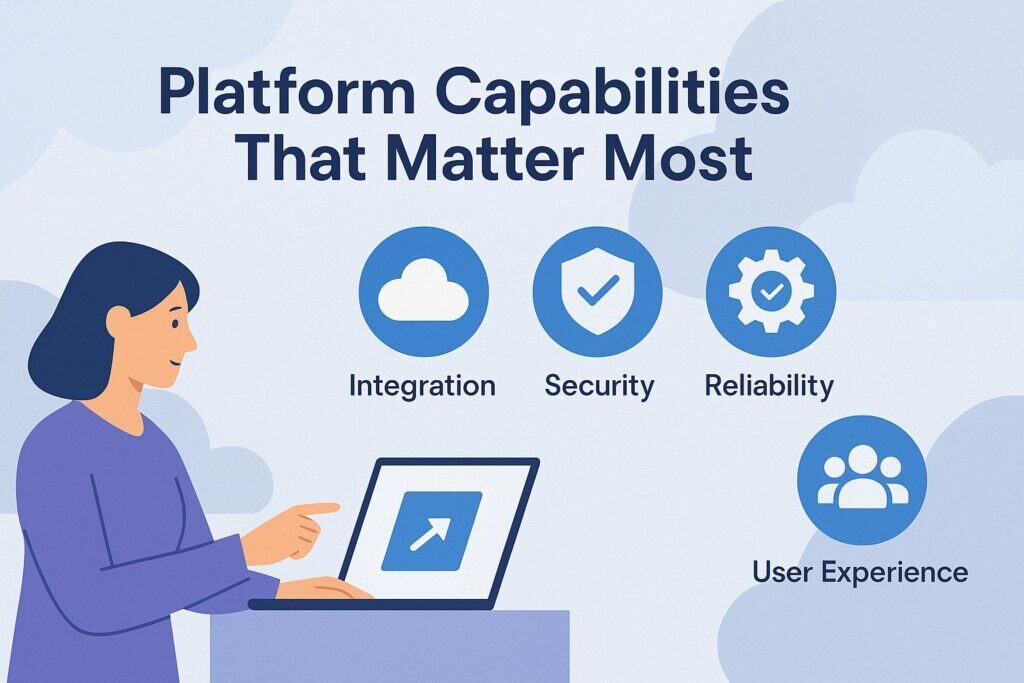
When selecting the best restaurant operations platforms for growing businesses, weigh these core capability buckets. Each one compounds benefits across speed, consistency, and profitability when executed well.
POS, Ordering & Channel Orchestration
Your POS is mission control for sales and guest interactions, but modern ordering spans dine-in, counter, drive-thru, QR, kiosk, web, native app, and third-party marketplaces.
The best restaurant operations platforms for growing businesses act as an order hub, normalizing menu data and order flows from all channels. Key capabilities include fast conversational ordering, item-level modifiers, coursing, seat mapping, tabs, bar features, and robust discount/void controls with role-based approvals.
Channel orchestration means menu parity (shared item library), throttling to protect kitchen capacity, and auto-86 that updates all channels when inventory runs low.
Drive-thru and kiosk require optimized UI flows, car-side timers, and upsell prompts. Online ordering should support white-label storefronts on your domain, guest accounts, saved payment methods, and loyalty integration.
Marketplace order aggregation (DoorDash, Uber Eats, Grubhub, etc.) should ingest orders directly into KDS with unified reporting, avoiding tablet farms.
The best restaurant operations platforms for growing businesses let you test channel-specific pricing, fees, and offers while preserving brand experience. Done right, you sell more with fewer errors—and your team spends less time juggling devices.
Inventory, Recipe Costing & Vendor Management
Food cost discipline separates thriving operators from struggling ones. Look for platforms with recipe management tied to theoretical food cost, item-to-vendor mappings, and near-real-time depletion from sales.
Mobile-first counts with barcode or shelf-to-sheet workflows reduce friction. Vendor catalogs should capture pack sizes, price histories, and approved substitutes, while order guides and par levels help managers reorder intelligently.
The best restaurant operations platforms for growing businesses catch margin leaks by surfacing purchase price variance, waste and yield, and theoretical vs. actual gaps, then tracing issues to items, stations, or shifts.
Advanced systems integrate prep sheets and batch recipes so you can forecast mise en place from upcoming orders and historical patterns. They also enable central kitchen/commissary flows: production plans, transfers, and lot tracking.
Even if you start simple, select a platform that grows into these capabilities. Inventory rigor compounds over time—establish clean vendor data, standardize recipes, and use the insights to guide menu engineering. This is where the best restaurant operations platforms for growing businesses pay for themselves.
Labor Forecasting, Scheduling & Compliance
Labor is your largest controllable expense. The best restaurant operations platforms for growing businesses deliver demand-based forecasting that translates sales projections into staffing guides by role and daypart.
Scheduling tools should honor availability, skill certifications, and labor laws (breaks, minors, split-shift premiums), while minimizing overtime. Mobile apps for shift bids, swaps, and time-off requests reduce manager overhead. Punch enforcement with grace periods and real-time alerts keeps timesheets clean.
Just as important are post-shift insights: labor vs. sales heatmaps, productivity metrics (guests per labor hour, sales per labor hour), and server/bartender performance. Integrations with payroll providers streamline processing, tips allocation, and tip credit compliance.
When labor planning connects with inventory and sales, managers can hit prime cost targets more consistently. The best restaurant operations platforms for growing businesses turn labor from a static schedule into a living plan that adapts to weather, events, and reservations.
Kitchen Display Systems (KDS) & Expo
KDS is where speed and accuracy happen. Seek rule-driven routing that sends items to the correct station (grill, salad, dessert) and highlights late tickets or rush orders. Expo screens should support course firing, hold-and-fire, all-day counts, and consolidated view for large parties or catering.
Bump logic, chits, and timers must be readable in harsh environments. The best restaurant operations platforms for growing businesses enable make-line optimization: recipe card pop-ups, allergy flags, and modifier clarity reduce remake waste.
Integration with online and marketplace orders eliminates rekeying and missed tickets. If you run drive-thru or curbside, pair KDS with order status boards and driver arrival detection to keep throughput high.
Data from KDS—ticket times by station, bottleneck analysis, and on-time rates—feeds continuous improvement. Over thousands of orders, small gains in seconds translate into big revenue and happier guests.
Payments, Security & Settlement
Payments power cash flow and guest trust. The best restaurant operations platforms for growing businesses support card-present EMV, contactless wallets, stored credentials for online orders, pay-at-table, split checks, and house accounts—all with PCI-compliant tokenization.
For tips, look for pooled or individual tip handling, auto-gratuity rules, and digital tip-out workflows. Beyond acceptance, examine settlement predictability, next-day funding, dispute tools, and detailed fee reporting. If the platform bundles processing, negotiate transparent, interchange-plus terms.
Security spans more than PCI. You want role-based access, audit logs, two-factor authentication, and P2PE (point-to-point encryption) on devices. The best restaurant operations platforms for growing businesses also handle tax logic correctly across jurisdictions, service charges, and surcharges.
For multi-unit operators, payments data should reconcile cleanly to deposits and export automatically to accounting. Smooth payments are invisible to guests—and priceless to finance.
Analytics, Menu Engineering & Data Warehouse Access
Decisions require trustworthy data. Insist on real-time dashboards with trend lines for sales, channel mix, labor, COGS, average check, item velocity, and voids/discounts.
Menu engineering should spotlight star, plowhorse, puzzle, and dog items and quantify how price or placement affects contribution margin. The best restaurant operations platforms for growing businesses enable cohort analysis for guests and unit benchmarking for operators.
For advanced teams, direct data access (scheduled exports or warehouse connectors) unlocks deeper analysis—weather and event overlays, churn models, or LTV predictions.
Ensure consistent data definitions across modules; “net sales” should mean one thing everywhere. With the right analytics, you’ll stop guessing what to 86, staff, or promote—and start acting with confidence.
All-in-One vs. Modular: Choosing the Right Approach

A classic debate when selecting the best restaurant operations platforms for growing businesses is all-in-one versus modular. All-in-one platforms promise simplicity: one vendor for POS, KDS, online ordering, inventory, labor, loyalty, and analytics.
You benefit from unified support, cleaner data flows, and fewer contracts. If your concept is straightforward, you can move quickly and reduce integration sprawl. The trade-off is potential feature depth—some modules may lag specialists—and vendor lock-in if APIs are limited.
Modular stacks pair a strong POS/KDS core with best-of-breed tools for reservations, loyalty, feedback, marketing automation, inventory, or accounting. This maximizes capability and innovation at the cost of integration complexity and multi-vendor coordination.
The best restaurant operations platforms for growing businesses make modular easy via open APIs, certified connectors, and battle-tested implementation playbooks.
A smart middle path is progressive modularity: start all-in-one for speed, then swap in specialist tools where ROI is proven (e.g., advanced loyalty or a data warehouse) while keeping the core stable. Your choice should reflect concept complexity, internal resources, and how much you value optionality over simplicity.
Recommended Stacks by Concept & Use Case
Matching stack to concept is a shortcut to finding the best restaurant operations platforms for growing businesses. Below are proven patterns that balance speed, cost, and capability.
Quick-Service Restaurants (QSR)
QSR thrives on throughput and consistency. Prioritize blazing-fast POS flows, resilient hardware, drive-thru timers, and KDS routing that keeps make-lines humming. Add kiosks or QR ordering to reduce queue friction, and use menu engineering to optimize combo builds and add-on prompts.
Inventory should tie to recipes with tight yield controls; forecasting feeds prep lists to prevent both stockouts and waste. Online ordering needs throttling and curbside coordination so digital doesn’t cannibalize in-store speed.
For labor, dynamic scheduling aligns headcount with daypart demand and weather. Payments must be tap-to-pay fast with wallet support and rock-solid offline mode. Analytics focus on ticket times, order accuracy, and contribution margin per channel.
The best restaurant operations platforms for growing businesses in QSR unify these pieces, making limited-time offers easy to launch across locations and marketplaces while protecting kitchen capacity. As you grow, central menu control and reliable hardware lifecycle planning keep every shift crisp.
Fast-Casual & Counter Service
Fast-casual blends customization with speed, so your platform must handle modifier-heavy menus elegantly—think build-your-own bowls or burritos—without slowing lines.
KDS should display all-day counts and route components to stations (grill, cold line, expo) with clear allergy flags. Digital ordering must mirror in-store choices, with pictures and upsells that translate to higher average checks. For off-premise, ensure order aggregation flows cleanly and 86 logic updates all channels.
Inventory precision underpins margin: recipe-level costing, prepped component tracking, and commissary support for multi-unit groups. Loyalty and CRM make a difference here—track preferences, run targeted offers, and measure repeat frequency.
Labor scheduling flexes around lunch rushes and caters to part-time availability. The best restaurant operations platforms for growing businesses help fast-casual operators A/B test pricing and menu placements across markets, then roll out winners quickly. With the right platform, your line stays moving while guests enjoy deep customization.
Full-Service Restaurants (FSR) & Bars
FSR requires robust coursing, seat mapping, check splitting, and tip management. Servers need conversational ordering with quick access to modifiers, wine notes, and allergy alerts. KDS/Expo must support hold-and-fire, coursed tickets, and chef-driven pacing.
Integrations with reservations and table management (waitlist, quote accuracy, turn times) are crucial to maximize covers without over-seating. Bars need tab handling, age verification workflows, and quick comp/void approvals.
Inventory should track pour costs and batch recipes (syrups, infusions), while labor tools manage separate FOH/BOH roles and tip pooling compliance. Payments benefit from pay-at-table or QR close-out to speed turns.
Guest engagement thrives with loyalty, feedback, and post-visit offers tied to preferences. The best restaurant operations platforms for growing businesses in FSR unify service finesse with back-office discipline, giving GMs live visibility into table status, course timing, and margin contribution—so hospitality leads and profitability follows.
Ghost Kitchens, Virtual Brands & Delivery-First
Delivery-first operations live and die by order aggregation, menu synchronization, and production efficiency. Your platform must ingest marketplace orders into KDS, maintain channel-specific pricing and menus, and throttle intelligently to avoid late orders.
Virtual brands require shared item libraries with separate brand storefronts and reporting. KDS should optimize for batch prep and driver pickup readiness; status boards and SMS updates reduce lobby congestion.
Inventory connects tightly to sales and forecasted orders to prevent out-of-stocks. With limited FOH, labor planning centers on kitchen capacity and driver handoff. Payments and settlements must reconcile marketplace fees, taxes, and promotions cleanly into accounting.
The best restaurant operations platforms for growing businesses in this category make launching new virtual brands as simple as cloning menu structures and assets, then pushing updates to all channels in minutes—not days.
Multi-Unit Operators & Franchises
Multi-unit groups need governance and consistency. Centralized menu management, price zones, and content approval workflows keep brands aligned while allowing local nuance.
Franchise models require role-based permissions so franchisors control standards and franchisees manage day-to-day operations. Inventory and purchasing benefit from corporate contracts and approved vendors with price audits. Accounting integrations should produce unit-level P&L with automated sales journals.
Training at scale calls for standardized curricula and certification tracking. Analytics must roll up and drill down—from enterprise dashboards to store-level actionable insights.
The best restaurant operations platforms for growing businesses here offer deployment tooling, templated store builds, and data governance that prepares you for dozens or hundreds of locations. With a strong platform, opening store #20 feels like opening store #2.
Implementation Roadmap: From Pilot to Rollout
Even the best restaurant operations platforms for growing businesses under-deliver without a disciplined rollout. Start with a pilot at a representative store: high volume, typical menu complexity, and a manager who’s change-positive.
Map current workflows, then configure the platform to mirror (and improve) them. Build a data foundation—clean item library, standardized modifiers, accurate recipes, and tax rules. Train staff hands-on and gather feedback daily during the first two weeks.
Define go/no-go criteria before expanding: ticket times, order accuracy, staff adoption, and stability. Create a repeatable store-opening playbook: network readiness, device staging, menu import scripts, KDS layouts, and test cases.
Schedule cutovers early in the week, not on holidays or promo days. Assign super-users and set up a command channel for fast triage. Post-go-live, hold a retrospective: what slowed us down, what surprised us, what we’ll change next time.
With this rhythm, you’ll turn platform deployment into a core competence—one of the quiet superpowers of the best restaurant operations platforms for growing businesses.
Data Strategy & Metrics That Matter
Platforms create leverage only when data becomes action. Define a concise North Star scorecard and review it weekly.
Core KPIs include: net sales by channel, average check, item velocity, theoretical vs. actual food cost, waste %, labor % and $/LHP (labor hours productivity), ticket times by station, delivery on-time %, voids/discounts rate, guest repeat rate, and contribution margin by daypart.
The best restaurant operations platforms for growing businesses let you drill down from enterprise to unit to shift to item to uncover root causes.
Adopt data hygiene rituals: daily 86 reviews, weekly price and vendor audits, monthly recipe audits, and quarterly menu engineering cycles. Pipe key data to a central warehouse if your organization is data-mature, and marry it with weather, events, and marketing campaigns.
Build closed-loop experiments: test a price change or placement, measure impact, and keep what works. Over time, this discipline compounds into a competitive moat—your operations get smarter, faster, and more profitable with every shift.
Security, Compliance & Payment Standards
Trust is table stakes. The best restaurant operations platforms for growing businesses adhere to PCI DSS for payment security, leverage P2PE on terminals, and tokenize card data across channels.
For user security, require SSO, MFA, RBAC, and audit trails for sensitive actions (voids, comps, price changes). With privacy regulations tightening, ensure compliance with GDPR/CPRA where applicable and configure data retention policies that respect the principle of least privilege.
Operational compliance matters too. Labor modules should support breaking rules, minor protections, and fair workweek standards where mandated. For taxes, platforms must accurately calculate varying state and local taxes, service charges, and marketplace fees.
If you operate across borders, confirm currency handling and VAT/GST logic. The best restaurant operations platforms for growing businesses deliver observability: uptime transparency, incident response SLAs, and backups/disaster recovery plans. Security isn’t a feature you bolt on—it’s the foundation guests never see but always rely on.
Pricing Models & Negotiation Tips
Vendors price platforms in different ways: per-terminal, per-location, per-module, per-order, or via bundled tiers. Payment processing may be required (with a margin over interchange) or optional. To evaluate the best restaurant operations platforms for growing businesses, request a clear rate card, projected 3-year TCO, and renewal terms.
If processing is bundled, push for interchange-plus with transparent authorization, assessment, and processor fees—not opaque blended rates. For software, forecast the modules you’ll realistically add within 12 months so you don’t get surprised later.
Negotiate implementation credits, hardware discounts, premium support, and price-lock periods. Tie a portion of fees to hitting deployment milestones. Ask for exit clauses tied to uptime and support SLAs.
If you’re a multi-unit operator, leverage volume for better terms and hardware refresh cycles. The best restaurant operations platforms for growing businesses will engage as partners, not just vendors—offering roadmap visibility, co-marketing support for openings, and access to product betas when relevant. A fair deal sets the tone for a long, productive relationship.
FAQs
Q.1: What’s the difference between a POS and a restaurant operations platform?
Answer: A POS primarily handles order entry and payment at the point of transaction. A restaurant operations platform goes further, unifying POS with KDS, inventory, labor, online ordering, delivery aggregation, loyalty, analytics, and payments into a single ecosystem.
The best restaurant operations platforms for growing businesses act as a command center that standardizes data and workflows across locations and channels.
This reduces errors, speeds up service, and provides the insights needed to improve margins and scale. In short, the POS is one component; the platform is the whole machine that runs your restaurant.
Q.2: How do I know if my business is ready to upgrade platforms?
Answer: Signals include opening new locations, launching virtual brands, struggling with menu changes across channels, inconsistent inventory counts, and poor visibility into food or labor variance. If your team relies on manual spreadsheets, duplicate data entry, or tablet farms for delivery orders, you’re a strong candidate.
The best restaurant operations platforms for growing businesses streamline these pain points, delivering faster time-to-market for menu changes, cleaner accounting, and lower operational risk. If you can quantify lost sales or waste from your current setup, the ROI case is usually clear.
Q.3: Should I choose all-in-one or modular?
Answer: If speed, simplicity, and single-vendor accountability matter most, start all-in-one. If your concept is complex or you have in-house tech muscle, a modular approach may deliver deeper capabilities.
The best restaurant operations platforms for growing businesses support both, letting you begin unified and then swap specialist tools where the payoff is clear. Ensure any path preserves data portability and avoids lock-in.
Q.4: How long does implementation usually take?
Answer: Timelines vary by scope, but a focused pilot can be up in weeks if menus, recipes, and tax rules are prepared. Multi-unit rollouts require a repeatable playbook: device staging, network checks, training, and go-live support.
The best restaurant operations platforms for growing businesses provide project management, checklists, and sandbox environments to accelerate cut-over with minimal disruption. Your biggest speed levers are clean data and decisive change management.
Q.5: What metrics should we review weekly?
Answer: Focus on net sales by channel, average check, item velocity, theoretical vs. actual food cost, waste %, labor %, ticket times, delivery on-time %, voids/discounts, and contribution margin.
The best restaurant operations platforms for growing businesses make these metrics visible in real time and explain outliers so managers can act—adjust staffing, refine prep, or tweak menus—before small issues become margin drains.
Conclusion
Choosing among the best restaurant operations platforms for growing businesses is a strategic decision that shapes your next decade, not just your next quarter. Look past feature checklists and judge platforms by how well they centralize truth, orchestrate channels, expose data, and scale with control.
Favor open APIs and ecosystems that give you options. Build a disciplined implementation and data cadence so insights become habits. When the right platform fades into the background during a Saturday rush and reappears as clarity in Monday’s review, you’ll know you chose well.
As your business grows—whether it’s more lines in a food hall, a second city for your fast-casual brand, or a franchise expansion—your platform should help you move faster, maintain consistency, and protect margin.
With the guidance above, you can identify, negotiate, and deploy the best restaurant operations platforms for growing businesses, turning technology into a competitive advantage that compounds shift after shift, store after store.