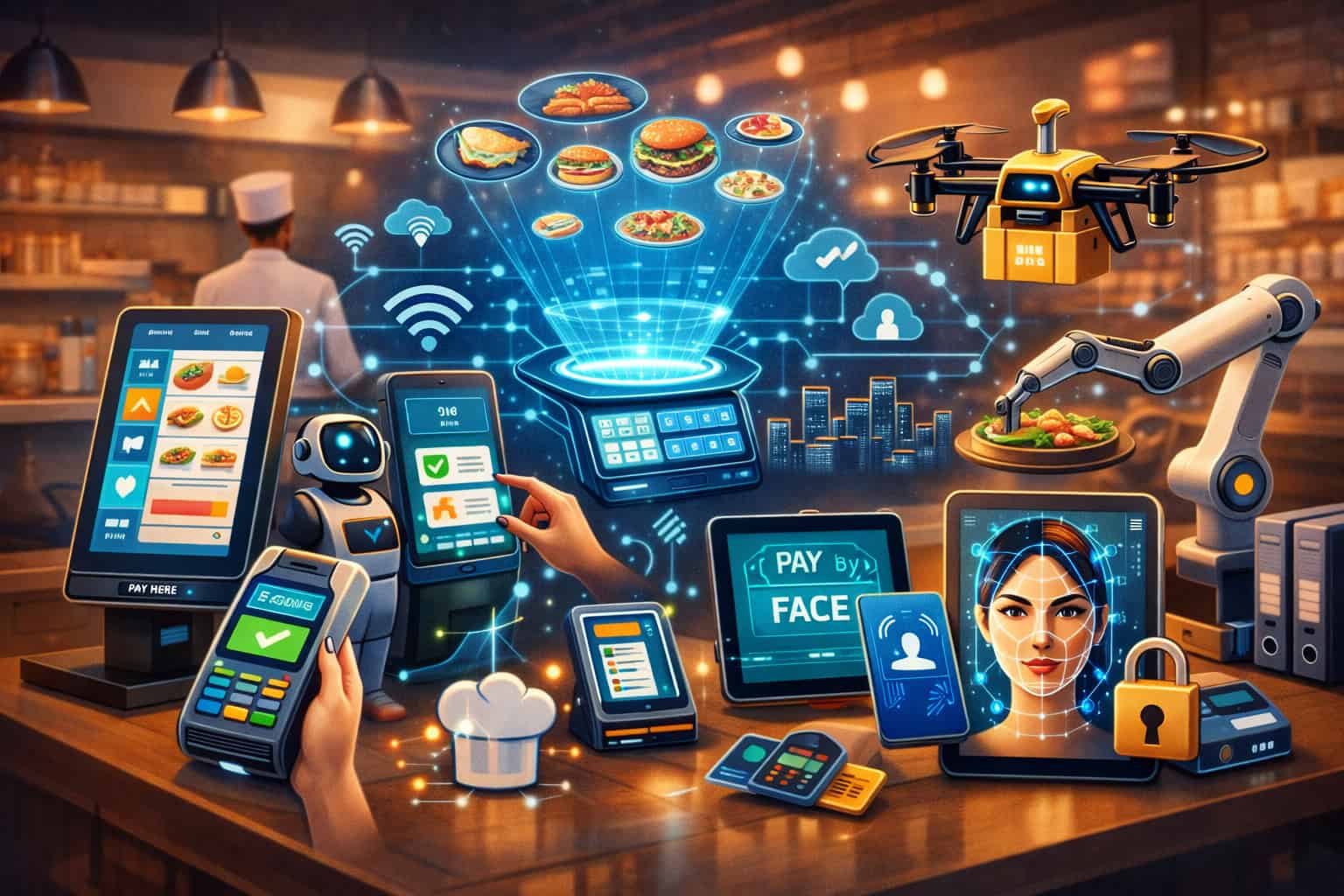
Restaurant POS technology is no longer “just a cash register.” It has become the operating system for modern food service—connecting ordering, payments, labor, inventory, loyalty, marketing, accounting, delivery, and reporting in one place.
Over the next few years, restaurant POS technology will evolve even faster because operators are facing the same reality everywhere: higher labor costs, tighter margins, rising guest expectations, more off-premise demand, and a growing need to protect payment data.
The biggest shift is that restaurant POS technology is moving from transaction management to decision intelligence. Instead of only tracking what happened, the best platforms will predict what’s likely to happen next—then recommend actions (and sometimes automate them).
That includes forecasting labor needs, highlighting menu items that are drifting into low profitability, suggesting smarter discounts, and detecting fraud patterns before losses add up. Vendors are already pushing into AI-driven restaurant workflows, including new intelligence layers designed specifically for restaurant operations.
In this guide, you’ll learn the most important restaurant POS technology trends shaping 2026 and beyond, how they work, what to plan for, and which upgrades typically deliver the best ROI for different restaurant models—quick service, fast casual, full service, bars, and multi-location groups.
Cloud-Native Restaurant POS Technology Becomes the Default
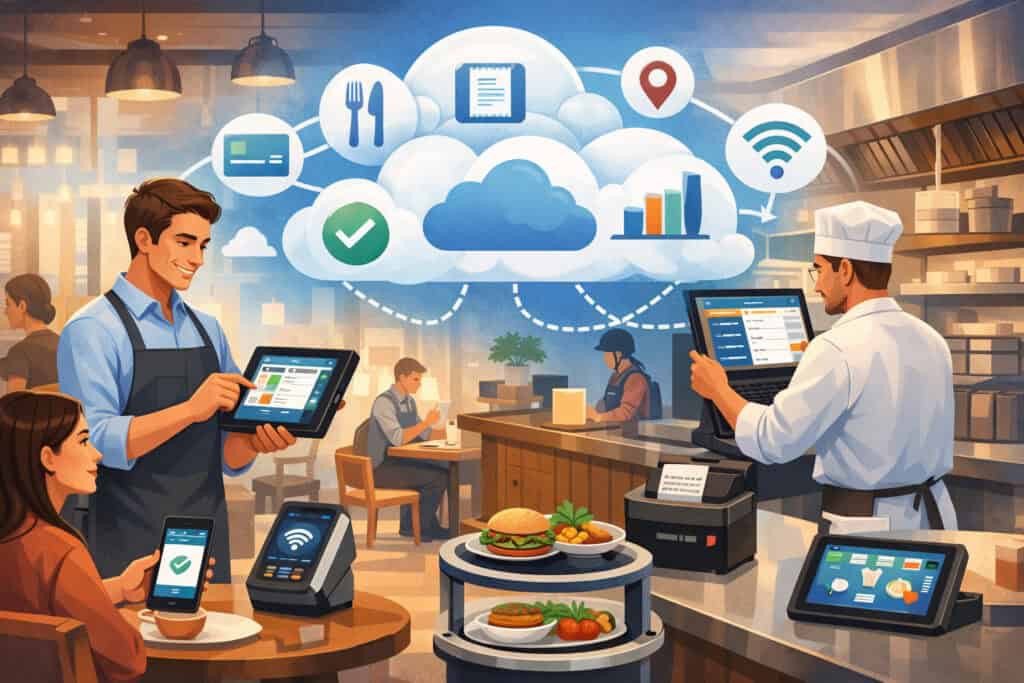
Cloud adoption in restaurant POS technology is not just a hosting choice—it changes how restaurants operate day to day. Cloud-native systems centralize data, make updates easier, enable real-time dashboards from anywhere, and simplify multi-location management.
That means your menu changes, taxes, item availability, and pricing can sync across registers, kiosks, and online ordering without manual updates at every terminal. For operators juggling multiple revenue channels, cloud is becoming the standard foundation rather than a premium add-on.
Another key advantage is speed of improvement. Traditional systems often rely on slower upgrade cycles, hardware-heavy installs, and on-site changes. Cloud platforms ship frequent improvements—sometimes weekly or monthly—adding small features that compound into meaningful efficiency gains over time.
Release notes from major vendors show steady additions around back-office workflows, scheduling enforcement, and better device synchronization—exactly the practical details restaurants need.
Cloud also supports “modular growth.” A single-location cafe can start with core POS + card acceptance, then add online ordering, loyalty, inventory, labor tools, or a kitchen display system as volume grows.
This matters because restaurant tech budgets are often phased—operators invest when they can tie the purchase to measurable returns like faster ticket times, fewer comps, or reduced overtime.
Cloud + Edge Architecture (Why Offline Mode Still Matters)
Even with cloud-first restaurant POS technology, reliable service during internet interruptions remains critical. That’s why the next phase is cloud + edge architecture: transactions can continue locally (edge) and sync to the cloud when connectivity returns.
Expect vendors to invest more in resilience, including stronger offline workflows for payments, kitchen routing, and order throttling during peak hours.
This matters most for high-volume environments where downtime equals lost revenue: busy lunch rushes, drive-thru lanes, stadium concessions, and nightlife operations. Edge support also helps protect the guest experience. Guests don’t care why a system is down—they only remember the wait.
A strong future-proof checklist for restaurant POS technology includes:
- Verified offline mode that still prints or routes orders
- Automatic data sync with conflict resolution
- Local menu cache and price/tax rules
- Redundant receipt/kitchen routing
- Offline-safe staff clock-in/out policies
Cloud is the future, but “cloud-only” without edge resilience is risky. The strongest restaurant POS technology platforms will balance both.
Multi-Location Management and Remote Ops Become Built-In
As groups expand, restaurant POS technology must function like a command center. Multi-location operators want consolidated reporting, role-based permissions, standardized menus, and location-level exceptions (for local pricing, taxes, or seasonal items).
The trend is that enterprise-level capabilities will become accessible to smaller groups because cloud software reduces complexity and deployment friction.
You’ll also see stronger remote tools that help operations leaders act quickly:
- Live sales and labor dashboards
- Remote menu updates and item 86’ing
- Centralized gift cards and loyalty wallets
- Alerts for unusual voids, discounts, or refunds
- Automated end-of-day reconciliation workflows
The future is “ops in real time,” not next-day reporting. Vendors are clearly positioning restaurant POS technology as end-to-end restaurant management, not just front-of-house checkout.
AI-Powered Restaurant POS Technology Moves From Reports to Actions
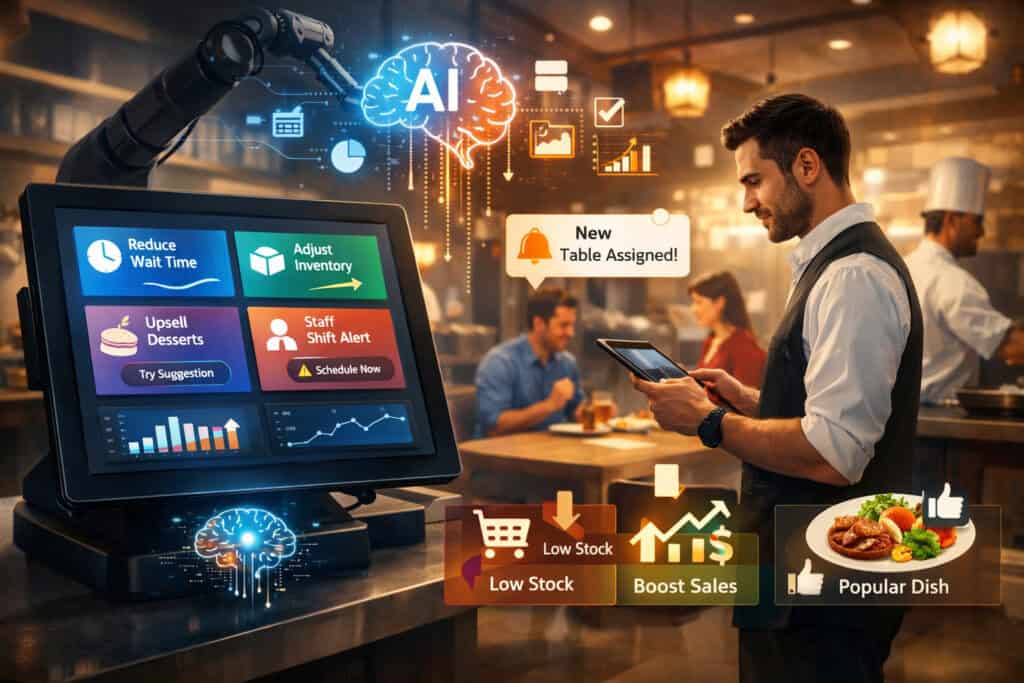
AI is rapidly becoming the most important differentiator in restaurant POS technology. The early phase of “AI in restaurants” was mostly analytics: dashboards that summarize sales, labor, and menu performance.
The next phase is AI that recommends and automates. That means smarter labor scheduling, automated inventory alerts, menu optimization, personalized upsells, fraud detection, and guest segmentation—built directly into workflows rather than buried in reports.
Large restaurant POS technology providers are already launching AI intelligence layers designed to help restaurants benchmark performance and streamline decisions.
What’s changing is the interface: operators will increasingly interact with their restaurant POS technology using conversational tools (“Why was labor high yesterday?” “Which items are dropping in margin?” “What promo should I run this week?”). That reduces the time it takes to turn data into action—especially for independent operators who don’t have analysts on staff.
AI also helps solve a labor reality: restaurants are busy, managers multitask, and training time is limited. AI can guide new managers toward consistent decisions, reducing performance variance across shifts and locations.
Predictive Forecasting: Labor, Inventory, and Prep Planning
Predictive forecasting is where AI becomes practical. Restaurant POS technology already holds valuable signals: historical sales patterns, item mix, channel mix (dine-in vs. pickup), daypart spikes, seasonality, and promo lift. AI can use those signals to forecast staffing needs by hour, recommend prep quantities, and warn about likely stockouts before service starts.
Forecasting also supports smarter scheduling. If your restaurant POS technology knows you typically get a late surge on Fridays when a nearby venue has events, it can recommend staffing adjustments and help reduce overtime surprises. Over time, forecasting will become more “context aware” by incorporating:
- Local event calendars
- Weather signals (where integrated)
- Delivery platform demand curves
- Reservation and waitlist volume
- Catering orders and large party bookings
The “future trend” prediction: forecasting will become a default setting in restaurant POS technology, not a premium module—because it directly improves labor efficiency, food cost control, and guest experience.
AI-Driven Menu Engineering and Dynamic Profitability
Menu engineering used to be a quarterly exercise. Future restaurant POS technology will push it toward a continuous loop—tracking contribution margins, modifier trends, waste signals, and discount behavior in near real time. AI will flag menu items that look profitable on paper but become margin drains due to modifier patterns or frequent comps.
Dynamic profitability is also gaining attention because ingredient costs fluctuate. More restaurant POS technology platforms will connect to inventory and purchasing data to show margin changes sooner. That means restaurants can adjust portion guidance, modifier pricing, or promo focus before a margin slide becomes a monthly surprise.
Expect AI tools to:
- Recommend price changes within guardrails
- Suggest bundling strategies that protect margin
- Identify server upsell patterns and training gaps
- Detect “discount leakage” (excess comps/voids)
- Propose limited-time offers based on demand signals
This is where restaurant POS technology becomes a profit co-pilot, not just a transaction recorder.
Digital Ordering, Kiosks, and Frictionless Checkout Become Standard
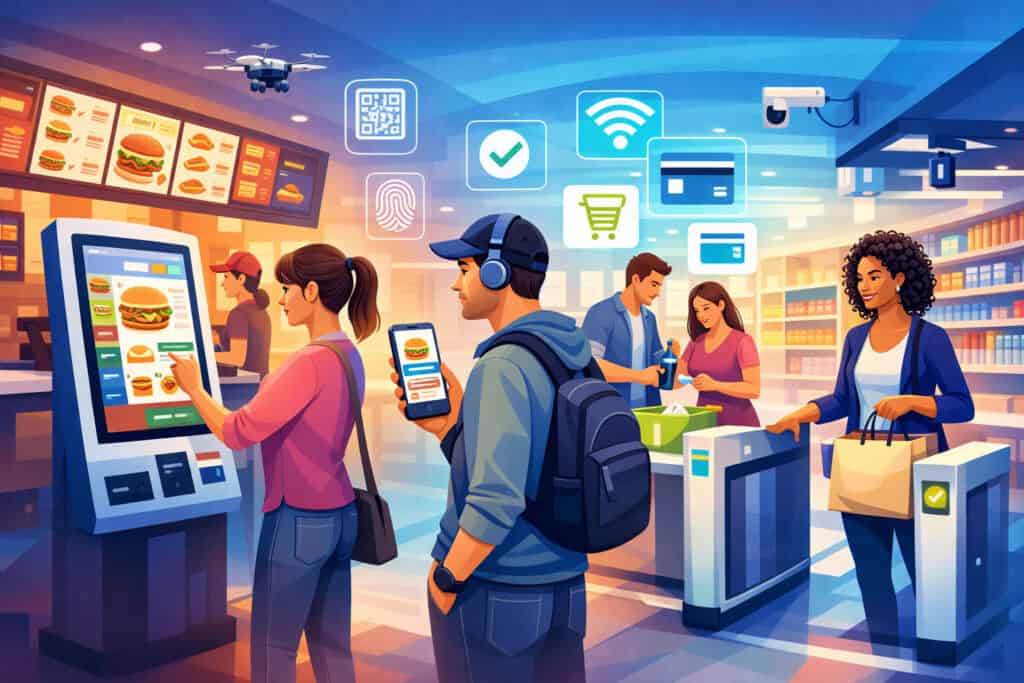
Restaurant POS technology is being reshaped by the guest’s expectation of convenience. Digital ordering is no longer only for large brands. Guests increasingly prefer options like QR ordering, mobile checkout, kiosks, and direct online ordering—especially when it reduces wait times and increases order accuracy.
A major trend is commission-free direct ordering: restaurants are investing in owned channels so they can reduce dependency on third-party marketplaces and keep more margin. Industry trend coverage for 2025–26 highlights direct ordering, AI-backed operations, smart kitchens, and cloud platforms as key drivers for restaurants trying to protect profitability.
As digital ordering grows, restaurant POS technology must unify menus, pricing, taxes, modifiers, and throttling rules across all channels. If your kiosk menu differs from your online menu, training and execution become messy. The future winners will be restaurants whose restaurant POS technology keeps every channel consistent.
QR Ordering and Pay-at-the-Table: Faster Turns, Better Experience
QR ordering and pay-at-the-table tools are moving from “pandemic-era convenience” to normal operations—especially in high-traffic dining rooms and bar environments. The biggest upside is faster table turns and reduced payment friction. Guests can split checks, tip, and pay when ready without waiting for a server to run cards back and forth.
The next trend is tighter integration: QR ordering won’t live in a separate system. It will be a native part of restaurant POS technology with shared customer profiles, loyalty, and item availability rules. That creates smoother service because:
- Orders go directly to the right prep station
- Modifier logic matches in-house ordering
- Out-of-stock items can be auto-hidden
- Payments reconcile automatically in one ledger
Future prediction: as more guests adopt digital payment behaviors, pay-at-the-table will become a default expectation in many full-service environments, similar to how tap-to-pay became normal in retail.
Self-Serve Kiosks and Smart Pickup: The New Front Door
Kiosks are becoming a core strategy for quick service and fast casual brands. The reason is simple: kiosks increase throughput and consistency while reducing pressure on the front counter. They also tend to increase average order value through structured upsell flows and visual menus.
Smart pickup is the companion trend: shelves, cubbies, SMS updates, and “order status” screens that reduce congestion and improve handoff accuracy. When kiosks, online ordering, and pickup flows are all tied into restaurant POS technology, the kitchen can throttle orders, prioritize based on promised times, and maintain accuracy.
The future trend is guest-flow design powered by restaurant POS technology:
- Order entry (kiosk/QR/app/counter)
- Production routing (KDS + expo view)
- Status tracking (prep → ready)
- Handoff verification (name/QR confirmation)
- Post-visit engagement (receipt + loyalty prompt)
Payments Innovation Shapes Restaurant POS Technology
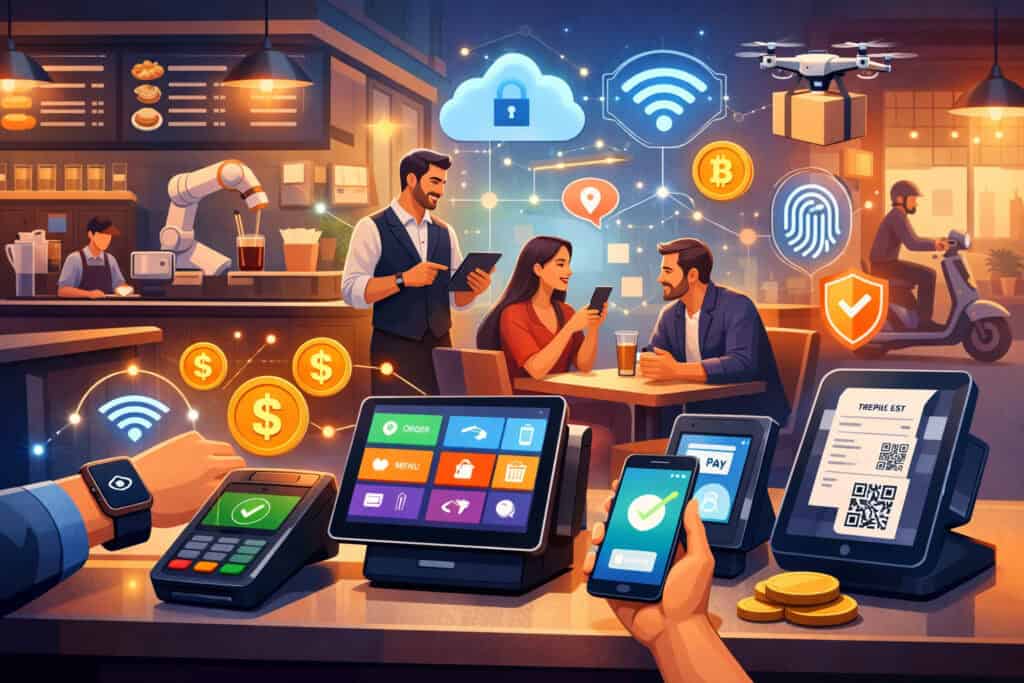
Payments are not separate from restaurant POS technology—they are one of its most important layers. Over the next few years, restaurants will see faster and more flexible payment options, stronger fraud controls, and increased pressure to meet security standards. The goal is to reduce chargebacks, improve approval rates, and make checkout feel effortless for guests.
One important driver is compliance. Payment security standards are evolving, and many requirements that were once “recommended” are becoming expected in practice. Industry commentary points to PCI DSS 4.0 changes becoming increasingly mandatory over 2025 and shaping merchant operations into 2026 and beyond.
That affects restaurant POS technology decisions because the easiest path is to choose systems that reduce your payment data exposure through tokenization, encryption, and validated device security.
At the same time, guest expectations are rising: tap-to-pay, mobile wallets, and contactless experiences are no longer niche. The future is “pay anywhere” and “pay instantly,” with fewer declines and fewer checkout delays.
Tokenization, Encryption, and “Reduced Scope” Security
A major future trend in restaurant POS technology is security architecture that minimizes risk. Tokenization replaces sensitive card data with a non-sensitive token, which can reduce exposure and simplify compliance when implemented properly. Security-focused PCI DSS 4.0 guidance frequently emphasizes tokenization and data protection as practical ways to reduce attack surface.
For restaurants, this matters because:
- Fewer systems touch sensitive card data
- Breach risk drops
- Compliance becomes more manageable
- Chargeback and fraud tooling improves
The future prediction: more restaurant POS technology will advertise “reduced PCI scope” as a selling point, especially for multi-location operators.
Embedded Payments and Smarter Approval Optimization
More vendors are pushing embedded payments—where processing is deeply integrated into restaurant POS technology. Embedded payments can improve reconciliation and reporting, but restaurants should evaluate trade-offs like processor lock-in, pricing transparency, and contract terms.
A major improvement area is approval optimization:
- Smarter retry logic for certain decline types
- Better routing decisions for card-present vs. card-not-present
- Improved handling of tips and incremental authorizations
- Cleaner void/refund flows to reduce disputes
When payments and POS data are unified, restaurants can also detect suspicious patterns faster—like unusual refund activity, repeated manual card entry, or inconsistent tip behavior. That’s where restaurant POS technology becomes part of fraud prevention, not just payment acceptance.
Smart Kitchens and Automation Redefine Throughput
Kitchen execution is where restaurant POS technology either wins or fails. The future trend is clear: more restaurants will adopt kitchen display systems (KDS), automated routing, and real-time prep coordination to increase speed and accuracy. With labor tight, restaurants are using technology to make teams more effective rather than simply adding headcount.
Trend reporting for 2025–26 repeatedly highlights “smart kitchens,” automation, and operational intelligence as core themes in restaurant technology. This is not hype—small improvements in ticket time and accuracy can meaningfully increase revenue at peak hours.
Automation also helps consistency. When restaurant POS technology routes orders automatically based on rules (station, item type, modifiers, promise time), it reduces training burden and prevents mistakes during rushes.
Next-Gen KDS: Timing, Throttling, and Expo Intelligence
Modern KDS tools are moving beyond digital tickets. Future KDS integrated with restaurant POS technology will support:
- Dynamic prep timing based on item complexity
- Order throttling when the kitchen hits capacity
- Expo screens that prioritize by promise time
- Real-time “bottleneck alerts” (e.g., fry station overload)
- Automated firing rules for coursing and pacing
For full service, coursing and pacing improvements reduce guest complaints and improve table turns. For quick service, throttling protects service quality by preventing the kitchen from being overwhelmed with simultaneous online orders.
Future prediction: KDS will increasingly include AI suggestions—like recommending temporary menu suppression (hide certain items for 20 minutes), staffing alerts (“add one person to expo”), or modifier prompts that reduce remake risk.
Robotics and Semi-Automation: Where It Actually Fits
Robotics in restaurants is growing, but the realistic near-term future is semi-automation: tools that reduce repetitive labor rather than fully replacing staff. Think beverage stations, automated fry management, smart ovens, or ingredient dispensing.
Restaurant POS technology will act as the orchestrator—sending signals to kitchen systems based on order flow and tracking production status. This matters most for high-volume concepts with repeatable menus.
For independent restaurants with highly variable menus, robotics adoption will be slower, but smart kitchen tools like KDS and prep forecasting will still deliver strong returns.
Data Unification, Loyalty, and Personalization Become the Growth Engine
The next era of restaurant POS technology is about turning operational data into guest growth. Restaurants want repeat visits, higher lifetime value, and better marketing efficiency. That requires unifying guest data across dine-in, pickup, delivery, catering, and events—then using it responsibly to personalize offers.
AI-driven restaurant tools are already pushing toward benchmarking and personalization, helping restaurants automate workflows and tailor offerings based on patterns. The future trend is deeper segmentation and smarter incentives:
- Win-back offers for lapsed guests
- VIP perks for high-frequency guests
- Personalized upsells based on favorites
- Birthday and occasion-based campaigns
- Time-limited offers tied to slow dayparts
Restaurant POS technology will increasingly measure marketing not by “campaign opens” but by real outcomes: incremental visits, incremental spend, and margin impact.
Loyalty 3.0: Wallet-Based, Omnichannel, and Instant
Older loyalty programs were often punch cards or points that lived in a separate database. Loyalty 3.0 will be:
- Wallet-based (phone number, QR, or app)
- Omnichannel (works across all ordering modes)
- Instant (rewards apply automatically at checkout)
- Margin-aware (offers prioritize profitability)
Expect restaurant POS technology to include more built-in loyalty features so restaurants don’t need multiple vendors. For multi-location groups, loyalty unification becomes even more valuable—guests earn and redeem across locations, and brands gain a clearer view of behavior.
Future prediction: the strongest loyalty programs will integrate with pay-at-the-table and digital receipts, prompting reviews, referrals, and return visits without adding friction.
Privacy-Safe Personalization and First-Party Data Strategy
As data privacy expectations rise, restaurants need a first-party data strategy that respects consent and transparency. Restaurant POS technology will continue shifting toward first-party data (owned by the restaurant) rather than relying on third-party marketplaces.
What “privacy-safe personalization” will look like:
- Clear opt-ins for marketing messages
- Easy preference management
- Secure storage of customer profiles
- Minimal retention of sensitive data
- Loyalty identity that works without invasive tracking
This is not only about compliance—it’s about trust. Restaurants that personalize responsibly will keep guests longer and reduce marketing waste.
FAQs
Q.1: What is the biggest future trend in restaurant POS technology?
Answer: The biggest future trend in restaurant POS technology is the move from basic reporting to AI-driven operational intelligence—systems that don’t just show data, but recommend actions and automate decisions.
Instead of only telling you sales numbers and labor percentages, modern restaurant POS technology is beginning to forecast staffing needs, highlight menu margin risks, suggest upsells and promotions, and detect suspicious transaction behavior.
Providers are actively building AI layers and assistant-style tools to help restaurants streamline decisions and personalize operations. This trend matters because most restaurants don’t have time for complex analytics. AI features reduce the gap between knowing and doing.
Over the next few years, expect AI to become a default expectation for competitive restaurant POS technology platforms—especially as operators focus on margin protection, labor efficiency, and faster service.
Will restaurant POS technology replace staff with automation?
Restaurant POS technology will not “replace staff” across most restaurants, but it will reduce repetitive work and help teams do more with fewer steps.
The most realistic adoption is semi-automation: kiosks for ordering, KDS for kitchen coordination, pay-at-the-table for faster checkout, and forecasting tools that reduce waste and overtime.
In high-volume concepts, kiosks and smart pickup systems can reduce pressure on counter staff. In full service, QR pay and tableside payment can reduce payment delays and free servers to focus on hospitality. The net impact is typically productivity improvement—not a fully staffless restaurant.
Future prediction: automation will expand fastest where menus are standardized and throughput is the main constraint. In chef-driven or highly customized concepts, restaurant POS technology will focus more on coordination, accuracy, and guest experience than robotics.
How do security standards affect restaurant POS technology decisions?
Security standards increasingly influence restaurant POS technology because restaurants must protect payment data and reduce breach risk. PCI DSS 4.0 changes and enforcement timelines are pushing more merchants toward stronger controls, better evidence tracking, and safer data handling approaches into 2026 and beyond.
In practice, restaurants should prioritize restaurant POS technology that supports tokenization, encryption, secure device management, and minimal handling of sensitive card data. Tokenization and modern security design can reduce your exposure and simplify compliance when implemented correctly.
Are kiosks and QR ordering still growing, or was that temporary?
Kiosks and QR ordering are still growing because they solve ongoing operational problems: labor pressure, long lines, order accuracy, and guest convenience.
The next step is integration—restaurants want kiosks and QR ordering fully connected to restaurant POS technology so menus, modifiers, pricing, taxes, and availability stay consistent across every channel.
QR ordering is especially valuable in busy dining rooms and bars where guests prefer speed and control. Kiosks work best in quick service and fast casual where throughput and order consistency matter most.
How can I future-proof my restaurant POS technology investment?
To future-proof restaurant POS technology, focus on flexibility, integrations, and data ownership. Look for:
- Cloud + offline/edge resilience (keeps you running during outages)
- Strong multi-channel ordering support (in-store + online + pickup)
- Modern payments security (tokenization, encryption, device controls)
- Open integrations (accounting, inventory, delivery, reservations)
- AI roadmap for forecasting, menu optimization, and labor insights
- Clear contract terms and transparent pricing
Future-proofing is less about buying “the most advanced system” and more about ensuring your restaurant POS technology can evolve without forcing a full replacement in two years.
Conclusion
Restaurant POS technology is entering a new phase: from transaction processing to intelligent, unified restaurant operations. Cloud-native platforms will continue to dominate because they make multi-location control, rapid updates, and omnichannel consistency easier.
AI features will expand quickly, shifting restaurant POS technology from passive reporting to proactive recommendations and automation—especially in labor forecasting, menu engineering, and operational decision support.
At the same time, guest experience will keep driving innovation. Expect more pay-at-the-table, QR ordering, kiosks, and smart pickup flows—tightly integrated so restaurants can manage one menu, one set of rules, and one data system across every channel.
Security will also shape decisions, as evolving standards push restaurants toward tokenization, encryption, and architectures that reduce payment data exposure.
The clearest future prediction is this: the most successful restaurants will treat restaurant POS technology as a strategic platform, not an expense. The right system won’t just ring up sales—it will protect margins, reduce chaos during rush, help train teams faster, and build repeat business through smarter data and personalization.