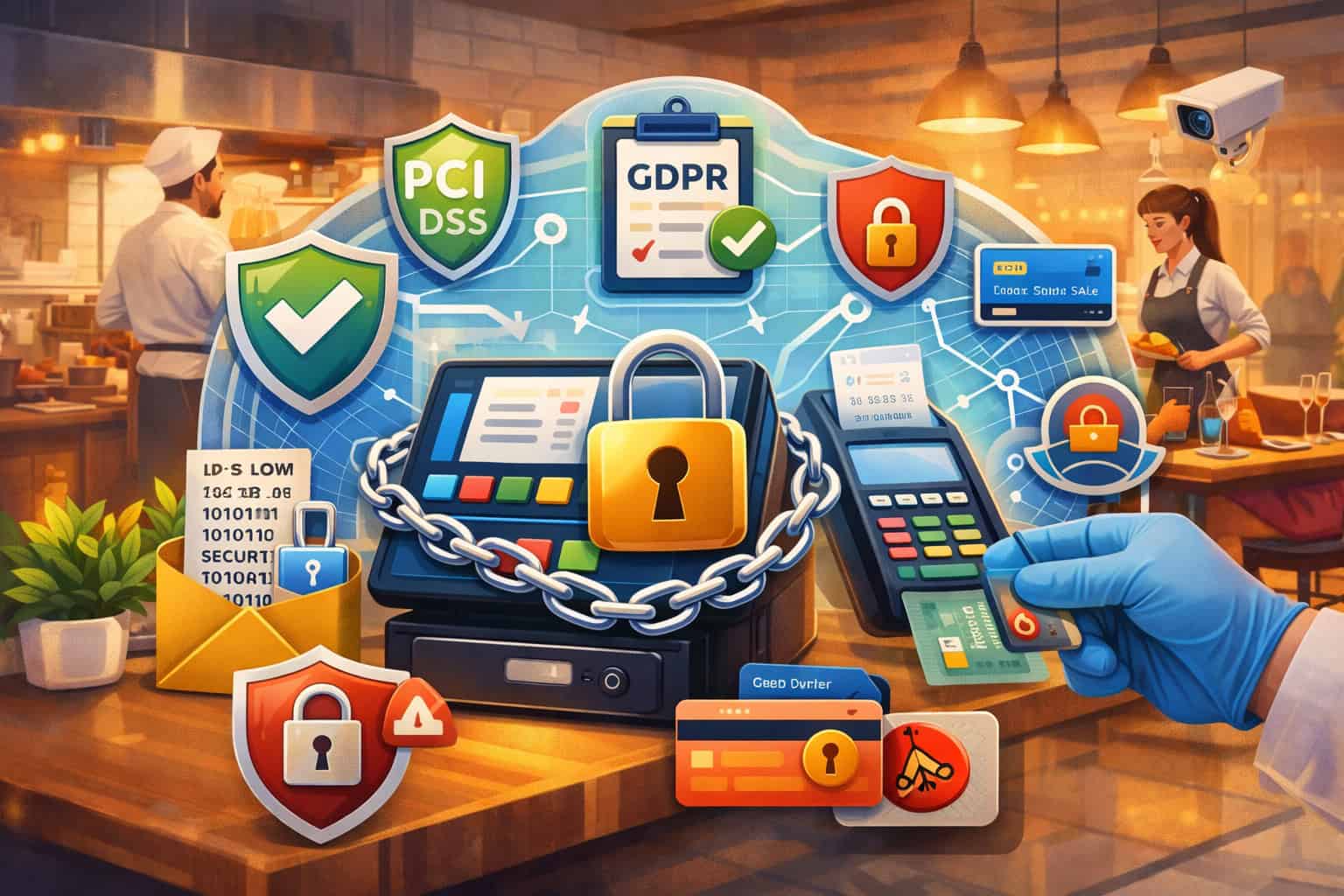
POS security and compliance for restaurants is no longer just an “IT problem.” A modern restaurant point of sale is a connected ecosystem: terminals at the counter, handheld tablets on the floor, kitchen display systems, online ordering integrations, loyalty apps, delivery marketplaces, Wi-Fi for guests, and remote vendor support.
Every connection creates convenience—and also creates risk. When attackers target restaurants, they often aim for what the POS touches: payment data, employee credentials, and operational continuity. That’s why POS security needs to be designed as a business process, not a one-time setup.
Restaurant POS security also ties directly to compliance. Payment brands expect you to follow the Payment Card Industry Data Security Standard (PCI DSS), and PCI DSS 4.0 introduced new requirements that became mandatory after March 31, 2025.
For restaurants, that change matters because it raises the bar on authentication, monitoring, vulnerability management, and vendor controls—areas where busy operations can easily cut corners.
This guide focuses on practical POS security and compliance for restaurants: how attacks happen, what PCI DSS expects, how to shrink your risk footprint, and how to build a routine that stays “audit-ready” without slowing service.
You’ll also find forward-looking predictions about restaurant POS security trends—because the best compliance strategy is one that remains effective as POS technology evolves.
Understanding the Restaurant POS Attack Surface
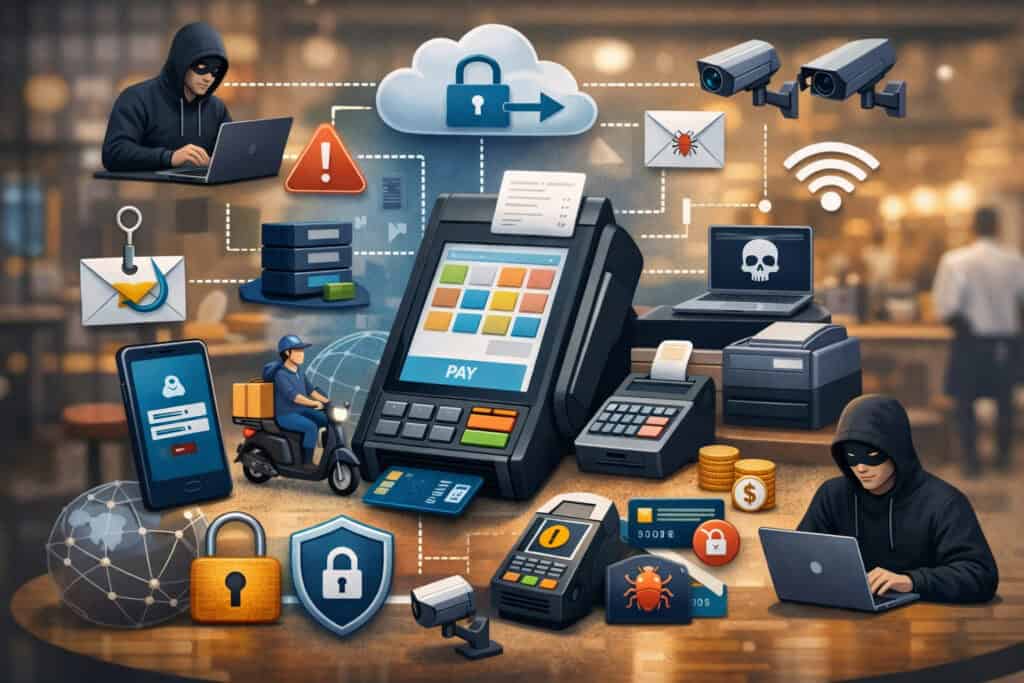
Restaurant POS security starts with understanding what you’re actually defending. Many restaurant owners think “POS” means the checkout screen and card reader.
In reality, the restaurant POS environment includes payment devices, POS software, the network connecting devices, the back-office server or cloud dashboard, and every integration that exchanges data with your POS. The attack surface grows each time you add a new tablet, plug in a printer, connect a delivery app, or allow a vendor to “remote in.”
From a POS security and compliance for restaurants perspective, the most dangerous attack paths are usually the simplest: weak passwords, exposed remote access tools, unpatched systems, and flat networks where one compromised device can reach everything else.
Attackers don’t need Hollywood hacking skills if a restaurant uses shared logins, never disables old employee accounts, or allows a POS terminal to browse the internet.
The operational nature of restaurants also creates unique risk. Staff turnover is high. Devices are used quickly under pressure. Managers prioritize speed and uptime.
That means POS security controls must be realistic: easy to use, hard to bypass, and resilient during peak hours. Good restaurant POS security protects revenue and reputation while keeping checkout fast and service smooth.
Common POS Security Threats Targeting Restaurants
The most common restaurant POS security threats fall into a few categories. First is credential theft—phishing emails, reused passwords, or staff tricked into sharing a login.
Once attackers get credentials, they often look for remote access systems or cloud dashboards. CISA’s guidance highlights how common phishing and malware are across industries, and restaurants are not immune.
Second is POS malware, which can be installed after attackers gain access through remote desktop tools or weak admin accounts. Older CISA reporting on POS malware campaigns describes attackers brute-forcing remote access and then deploying malware to exfiltrate payment data.
While tools and tactics evolve, the pattern remains relevant for POS security and compliance for restaurants: insecure remote access and weak admin controls can lead to payment data exposure.
Third is network-based compromise. If the guest Wi-Fi and POS share the same network, or if a compromised tablet can reach back-office systems, attackers can move laterally.
Fourth is supply chain risk—third-party integrations, vendor support accounts, and unmanaged plugins that expand your POS security scope.
Finally, ransomware is a growing operational threat because restaurants depend on uptime; attackers know downtime hurts and may pressure fast payment.
Why Restaurants Are Target-Rich for POS Attacks
Restaurants are attractive targets for a few reasons. They process high volumes of payment transactions, often with smaller IT budgets and limited in-house security expertise.
Many locations run similar setups across multiple stores, so one set of stolen credentials or one misconfiguration can scale into a multi-location incident. That’s a major concern for restaurant POS security because attackers love repeatable entry points.
Restaurants also have “always-on” workflows. Terminals stay powered. Managers want remote access for troubleshooting. Staff may use shared accounts to speed shift changes.
Those conveniences weaken POS security and compliance for restaurants if they aren’t controlled properly. A “shared manager login,” for example, makes it hard to prove accountability and makes incident response much harder.
Another reason is integration sprawl. Online ordering, loyalty platforms, inventory tools, payroll, scheduling, tip management, and delivery marketplaces all connect to your POS environment in some way.
Each integration becomes a data pathway that must be governed—what data is shared, how access is authenticated, and how vendors are monitored. Strong restaurant POS security treats third-party access like a first-class risk, not an afterthought.
Compliance Landscape: PCI DSS 4.0 and Beyond

For most restaurants, compliance starts with PCI DSS. PCI DSS is the baseline security standard for protecting cardholder data and securing payment environments.
PCI DSS 3.2.1 was retired March 31, 2024, and PCI DSS 4.0 became the industry standard, with future-dated requirements becoming mandatory after March 31, 2025. PCI DSS v4.0.1 was released as a limited revision in June 2024 with clarifications.
POS security and compliance for restaurants should be designed to meet PCI obligations without turning service into a compliance checklist. The practical goal is to reduce PCI scope—meaning fewer systems that “touch” card data—and then apply strong controls to the smaller environment that remains.
Many restaurants can reduce scope significantly by using validated point-to-point encryption (P2PE) solutions and keeping card data out of local networks and systems.
Beyond PCI DSS, restaurants also deal with privacy expectations and state-level requirements for personal information. Loyalty programs, stored profiles, and employee systems can introduce additional obligations.
Strong restaurant POS security supports compliance across all these areas by focusing on secure architecture, strong identity controls, continuous monitoring, and documented procedures.
PCI DSS 4.0 Changes That Matter Most to Restaurants
PCI DSS 4.0 emphasizes stronger authentication, better logging, more robust vulnerability management, and clearer responsibilities for service providers.
A key date for restaurant POS security and compliance for restaurants is March 31, 2025, when many “best practice” items became mandatory requirements. If you operate multiple locations, these requirements are especially important because the same weakness can replicate across every store.
Another major theme is continuous security rather than “annual compliance.” PCI DSS 4.0 pushes organizations toward ongoing risk management, testing, and monitoring. This aligns with real-world restaurant POS security: attackers don’t wait for audit season.
Restaurants should also pay close attention to vendor and remote access controls. Many POS compromises begin with third-party access, reused passwords, or poorly secured remote desktop tools.
The compliance expectation is that restaurants understand who has access, why they have it, how they authenticate, and how access is removed when no longer needed.
Finally, PCI DSS 4.0 supports more flexible implementation approaches, but flexibility doesn’t reduce accountability. Restaurant operators still need evidence: policies, access logs, patch records, vulnerability scans, and training records. Good POS security makes evidence collection automatic wherever possible.
How to Scope Your Cardholder Data Environment
Scoping is one of the most powerful levers in POS security and compliance for restaurants. Your “cardholder data environment” (CDE) includes systems that store, process, or transmit cardholder data—and also systems connected to them, depending on segmentation and architecture. The bigger the scope, the bigger the compliance workload and the bigger the risk.
To scope correctly, start with a payment data flow map. Trace what happens when a card is tapped, dipped, or swiped. Does the POS application ever see the card number? Does a receipt show too much detail? Do you store card data for tips, tabs, or recurring customers? Each of those decisions impacts restaurant POS security.
Next, identify connected systems: Wi-Fi routers, switches, back-office PCs, kitchen displays, printers, handhelds, and any device on the same network segments.
If you can isolate the payment environment from everything else, you can shrink scope dramatically. That’s why network segmentation and validated payment encryption matter so much in restaurant POS security and compliance for restaurants.
Finally, validate assumptions. Many restaurants assume they are “out of scope” because they don’t store card data, but integrations or misconfigurations can accidentally bring systems into scope.
A disciplined scoping process—supported by segmentation testing and vendor documentation—keeps your restaurant POS security strong and your compliance effort manageable.
Secure Architecture: Reduce Data and Reduce Risk

The most effective restaurant POS security strategy is architectural: avoid collecting sensitive data you don’t need, and keep payment data away from your general network.
When you do that, everything else becomes easier—compliance scope shrinks, monitoring becomes clearer, and incident response becomes faster. A secure architecture also improves uptime because your POS environment becomes more stable and less exposed to “random” network threats.
In POS security and compliance for restaurants, architecture usually comes down to three decisions. First: how payments are captured and encrypted. Second: how your network is segmented and managed. Third: how third-party integrations connect and authenticate. Getting these right early can prevent expensive rebuilds later.
Restaurants should also plan architecture with growth in mind. Adding a second location or expanding into online ordering often multiplies your attack surface. If your architecture is designed for one store with “temporary” workarounds, it will fail when you scale. Strong restaurant POS security makes scaling safer by default.
EMV, P2PE, and Tokenization in Restaurant POS Security
EMV (chip) and contactless payments reduce certain types of fraud, but EMV alone is not the same as POS security and compliance for restaurants. What matters for compliance is how payment data is encrypted and whether sensitive card data ever enters your environment in readable form.
Validated P2PE solutions encrypt card data immediately at the payment device and keep it encrypted until it reaches a secure decryption endpoint, reducing what your POS systems and networks can access.
Tokenization adds another powerful layer. Instead of storing a card number for tabs, refunds, or loyalty, your systems store a token that has no usable value if stolen. Tokenization is widely recommended in POS security because it reduces the impact of data exposure and can reduce compliance scope when implemented properly.
In a restaurant context, these tools must support real workflows: bar tabs, tipping adjustments, split checks, and offline mode. When evaluating vendors, ask specific questions: Is the P2PE solution validated? How is key management handled? Where are tokens stored? How are refunds and chargebacks handled without storing card numbers?
The best restaurant POS security design uses encryption in transit, strong protection at endpoints, and tokenization for any stored reference. That combination limits what attackers can steal and reduces what you must protect under PCI DSS.
Network Segmentation and Zero Trust for Restaurants
Network segmentation is a cornerstone of POS security and compliance for restaurants. If your POS terminals sit on the same network as guest Wi-Fi, office laptops, or smart TVs, a compromise in one area can spread. Segmentation means isolating payment-related devices and systems into a restricted network segment with tightly controlled traffic rules.
At a minimum, restaurants should separate: (1) payment/POS devices, (2) business systems like manager PCs and back-office tools, (3) guest Wi-Fi, and (4) IoT devices like cameras, thermostats, and signage. Then apply firewall rules that allow only required traffic. This reduces the “blast radius” of any single compromise and strengthens restaurant POS security.
A modern approach is “zero trust,” where no device is trusted by default. Every access request is authenticated, authorized, and logged. For restaurants, that can be practical: device certificates, strong Wi-Fi authentication for staff devices, and strict controls on which systems can talk to payment networks.
Even if you don’t implement full zero trust, applying the mindset improves POS security: least privilege network rules, deny-by-default policies, and continuous validation.
Segmentation also supports compliance evidence. When you can prove your payment environment is isolated, you can reduce scope and reduce audit complexity. That makes POS security and compliance for restaurants both stronger and simpler.
Hardening POS Devices and Back-Office Systems
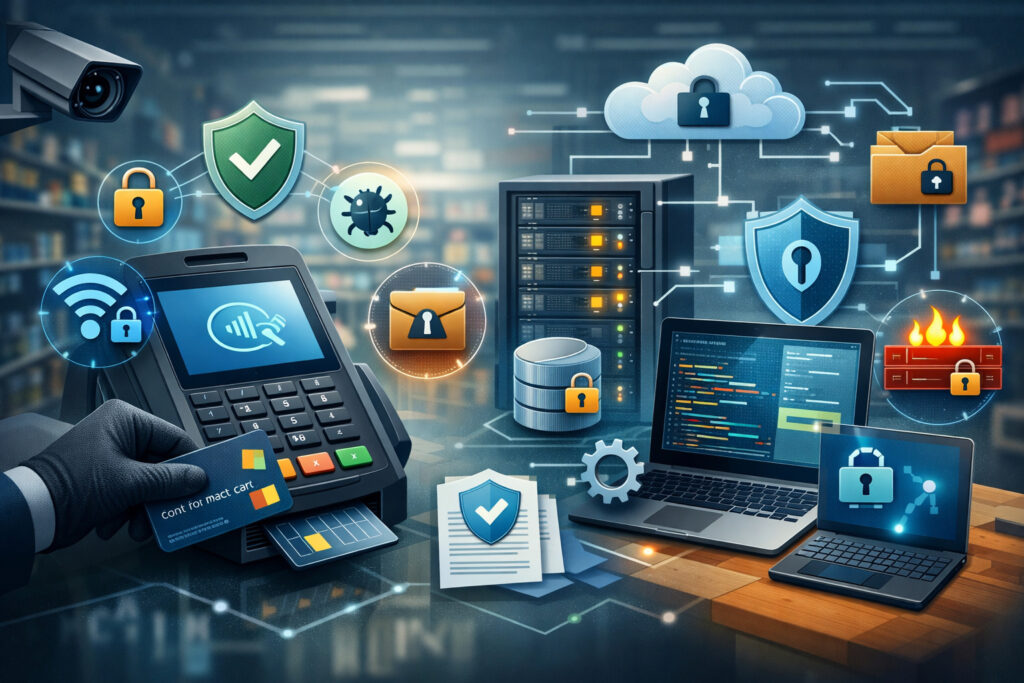
Even with great architecture, restaurant POS security can fail if endpoints are weak. POS terminals, tablets, and back-office PCs are high-value targets because they have direct access to operations.
If a terminal is compromised, attackers may capture credentials, manipulate transactions, or disrupt service. If a back-office system is compromised, attackers may access reports, employee data, and administrative controls.
Hardening means reducing the ways a device can be abused: minimize installed software, disable unnecessary services, lock down settings, enforce updates, and monitor behavior.
In POS security and compliance for restaurants, hardening is also where you turn “policy” into reality. A policy that says “install updates” is meaningless if devices can’t update reliably or if nobody owns the process.
Restaurants also need to harden their vendor relationships. Many POS systems rely on third-party support. If vendors require remote access, that access must be secured. A single weak remote access configuration can undermine every other POS security control.
Patch Management, EDR, and Application Control
Patch management is one of the most basic—and most frequently neglected—elements of restaurant POS security. Unpatched operating systems, outdated POS software, and vulnerable routers create easy entry points.
Restaurants should define a patch cadence: critical security updates within days, routine updates on a predictable schedule, and emergency procedures for actively exploited vulnerabilities.
Endpoint detection and response (EDR) or managed antivirus can detect suspicious behavior on POS endpoints and back-office machines. POS security benefits from tools that can detect malware, suspicious processes, and unusual network connections.
For smaller restaurants, a managed security provider can help by monitoring alerts and responding quickly, which is often more realistic than expecting staff to interpret security logs during dinner rush.
Application control (sometimes called allowlisting) is especially powerful for POS terminals. A POS device should not run random software. If only approved POS applications can execute, many malware attacks fail automatically.
This is a strong practical control for POS security and compliance for restaurants because it reduces reliance on staff behavior.
Finally, don’t forget physical hardening: lock terminals to counters, restrict access to ports, and ensure devices can’t be swapped or tampered with. Physical controls support restaurant POS security because attackers sometimes exploit unattended devices or accessible wiring.
Securing Remote Access and Vendor Support Channels
Remote access is one of the most common weak points in POS security and compliance for restaurants. Vendors and IT support teams often use remote tools to troubleshoot issues. If remote access is always enabled, protected by weak passwords, or shared among multiple technicians, it becomes an attacker’s doorway.
Restaurants should enforce these remote access principles: remote access only when needed, strong multi-factor authentication (MFA), unique accounts per technician, least privilege permissions, and logging of every session. If your vendor can’t support these requirements, that’s a restaurant POS security red flag.
Also, restrict where remote access can come from. Allow connections only from approved IP ranges or through a secure VPN with device checks. Disable direct exposure of remote desktop services to the internet.
Older POS malware campaigns often exploited weak remote access configurations and privileged accounts, which is why modern guidance stresses controlling access paths.
Vendor management is part of compliance, too. Your contracts should define security responsibilities: how quickly vulnerabilities are patched, how accounts are managed, and how incidents are reported.
Strong restaurant POS security treats vendors as part of your security perimeter and requires evidence—access logs, support tickets, and account lifecycle records.
Identity, Access, and Employee Practices
Restaurant POS security can be undone in seconds by weak identity practices. If everyone uses the same login, you can’t trace actions. If manager passwords are reused, attackers can guess them.
If former employees still have access, your risk grows with every staffing change. Identity security is also one of the most audit-visible areas of POS security and compliance for restaurants because it’s easy to test and easy to document.
The goal is simple: each person has their own account, permissions match their job role, and sensitive actions require stronger authentication. For restaurants, this must be balanced with speed. A good setup lets staff clock in quickly, ring orders fast, and avoid friction—without sacrificing POS security.
Employee practices matter as much as technology. A restaurant can buy the best POS system and still fail compliance if staff share credentials or approve “remote support” requests without verification. The strongest restaurant POS security programs train for real scenarios and build habits into daily routines.
Role-Based Access Control, Least Privilege, and MFA
Role-based access control (RBAC) is the backbone of POS security and compliance for restaurants. Servers should only access order entry and payment capture. Managers may need refunds, voids, and reports. Admin functions—like adding users, changing integration settings, or exporting data—should be restricted to a small set of trusted accounts.
Least privilege means users get only what they need, nothing more. This reduces damage from mistakes and reduces what attackers can do if they steal a staff account.
For example, a compromised server account shouldn’t be able to change bank deposit settings or create new admin users. That’s a practical restaurant POS security control with direct fraud prevention value.
Multi-factor authentication should be mandatory for admin access, remote access, and cloud dashboards. MFA dramatically reduces account-takeover risk, especially against phishing. If your POS vendor doesn’t support MFA for administrative accounts, consider that a serious compliance and security gap.
Account lifecycle is equally important. Create accounts when employees start, adjust roles when they change jobs, and disable access immediately when they leave. Restaurants with high turnover should automate this as much as possible, because manual offboarding is where POS security breaks under operational pressure.
Training, Insider Risk, and Shift-Change Controls
Training is often treated as a checkbox, but for restaurant POS security it’s a daily operational need. Staff should know how to spot phishing, recognize suspicious support calls, and handle payment device tampering. Short, frequent training works better than annual lectures—especially in restaurants where schedules rotate and teams change.
Shift changes are a critical moment for POS security and compliance for restaurants. Shared logins often happen because staff want speed. A better approach is fast user switching, tap-to-login badges, or short PINs combined with back-end controls and strong monitoring. The point is to keep individual accountability while maintaining service speed.
Insider risk is not just malicious. It includes accidental mistakes: a manager emailing reports to a personal address, a staff member plugging in a random USB cable, or someone disabling updates to avoid a reboot.
Restaurant POS security improves when processes are designed to be difficult to bypass. For example, restrict USB ports, enforce automatic updates during off-hours, and lock down system settings so staff can’t install apps.
Finally, build a verification culture. If someone calls claiming to be “POS support,” staff should verify through a known phone number or ticketing process. That simple habit can stop many social engineering attempts that target restaurant POS environments.
Monitoring, Logging, and Incident Response for Restaurants
POS security and compliance for restaurants requires visibility. You can’t defend what you can’t see. Monitoring means collecting logs and alerts from POS systems, payment devices, firewalls, and cloud dashboards, then reviewing them for suspicious activity.
For busy restaurants, monitoring must be streamlined. The goal is not to drown in alerts—it’s to detect meaningful threats early.
PCI expectations increasingly align with continuous monitoring and testing. When security becomes routine, compliance becomes a byproduct. Restaurants that treat monitoring as “only for audits” often discover incidents too late, after payment data or operational systems have already been affected.
Incident response is the other half of the equation. If something goes wrong—malware, stolen credentials, suspicious transactions—restaurants need a plan that works at 9 p.m. on a Saturday. Strong restaurant POS security includes a simple playbook: who to call, what to shut down, what evidence to preserve, and how to keep operations running safely.
Practical Logging and Alerting for Restaurant POS Environments
Start with the essentials. Log administrative logins, permission changes, remote access sessions, software updates, and network firewall events. If your POS is cloud-managed, enable audit logging in the dashboard. If you have multiple locations, centralize logs so you can spot patterns across sites.
For restaurants, a lightweight SIEM (security information and event management) or managed detection service can be practical, especially if you don’t have in-house security staff. The value is in correlation: a login from an unusual location plus a sudden permission change plus a remote session is a stronger signal than any single event.
Monitoring should also include operational anomalies that signal fraud. Examples: unusual refund spikes, voids at strange hours, repeated “failed login” events, or new devices joining the POS network. Many attacks begin with credential probing, so catching repeated failed logins early can prevent bigger compromise.
CISA’s broader guidance on malware and phishing reinforces the importance of detecting and responding quickly to common attack methods. Restaurant POS security benefits when alerts are tied to specific actions: lock accounts, require password resets, disable remote access, or isolate devices.
Incident Response, Breach Notification, and Recovery Planning
A restaurant incident response plan should be short and actionable. Define severity levels and triggers: suspected POS malware, confirmed credential theft, ransomware, payment device tampering, or suspicious vendor access.
Then define actions: isolate affected devices, disable remote access, rotate credentials, contact your POS vendor, and notify your payment processor as required.
Preserve evidence. Don’t wipe devices immediately unless advised by your incident response partner. Logs, device images, and network records may be needed to understand scope and support compliance reporting.
This is especially important in POS security and compliance for restaurants because payment brands and acquiring banks may require specific investigation steps.
Recovery planning also matters. Restaurants should have backups for POS configuration, menus, and reporting data. If you rely on internet connectivity for cloud POS, have a downtime procedure: offline mode, manual imprint or fallback payment methods, and clear rules for what data can be stored during outages.
Finally, breach notification obligations vary by state and by what data was affected. Even if card data is protected by P2PE, a breach might expose personal information (emails, phone numbers, loyalty profiles).
Strong restaurant POS security includes legal and communications contacts in the response plan so decisions aren’t improvised under stress.
Privacy, Data Retention, and State-Level Requirements
POS security and compliance for restaurants isn’t only about card data. Many restaurants collect personal information through reservations, waitlists, online ordering, loyalty programs, Wi-Fi sign-ins, and delivery integrations.
That data can include emails, phone numbers, addresses, and purchase history. If compromised, it can create customer trust issues and legal obligations.
Privacy is also tied to data minimization. If you don’t need to store something, don’t store it. If you need it, store it briefly and securely. Restaurant POS security improves dramatically when data retention is limited, access is restricted, and exports are controlled.
State-level rules can also influence security expectations. Some states describe “reasonable safeguards,” and regulators often look for written programs, vendor oversight, and protective controls.
For example, New York’s SHIELD Act describes administrative, technical, and physical safeguards and includes expectations such as training, service provider oversight, risk assessment, and testing.
Massachusetts regulations emphasize protecting personal information and maintaining a security program tailored to the business. These concepts map directly to strong restaurant POS security practices.
Loyalty Apps, Online Ordering, and Customer Data Protection
Loyalty programs and online ordering systems can expand POS security risk quickly because they introduce accounts, stored profiles, marketing permissions, and integrations.
Restaurants should treat these systems like sensitive platforms, even if they don’t store card numbers. Attackers may target loyalty accounts for fraud, steal customer contact data for phishing, or exploit APIs between the POS and third-party services.
Start by classifying data: what you collect, where it’s stored, and who can access it. Then enforce controls: MFA for administrative accounts, least privilege access for marketing tools, and encryption for data in transit and at rest.
Tokenization can help if payment data is involved, and secure API practices matter for POS security—rate limiting, strong authentication, and monitoring.
Data retention is one of the simplest privacy wins. Do you really need years of customer phone numbers? Do you need full addresses for pickup orders? Set a retention schedule and automate deletion. This reduces your breach impact and improves restaurant POS security and compliance for restaurants by narrowing what must be protected.
Finally, review vendor security posture. Delivery and ordering partners should provide clear documentation on how they protect data and how incidents are reported. Integrations should use secure credentials and should be rotated regularly. Restaurant POS security is weakest when integrations are treated as “set and forget.”
Employee Data, Biometrics, and Time-Clock Compliance
Employee systems are often overlooked in POS security and compliance for restaurants. Timekeeping tools, scheduling apps, payroll integrations, and HR portals may contain Social Security numbers, bank details, and addresses.
Some restaurants also use biometric time clocks—fingerprint or facial scans—to prevent buddy punching. Biometrics can create significant compliance risk depending on state law.
In Illinois, the Biometric Information Privacy Act (BIPA) is well known for strict requirements around notice, written consent, retention policies, and restrictions on disclosure for biometric identifiers.
For restaurants operating in that state, using fingerprint time clocks without compliant processes can lead to legal exposure. That means restaurant POS security must extend beyond payments into employee data governance: written policies, consent flows, and secure storage.
Even without biometrics, restaurants should protect employee data with the same seriousness as customer data. Enforce strong passwords and MFA for admin accounts, restrict who can export payroll or tax documents, and limit access to HR systems.
Also, ensure secure disposal of printed documents—W-2 forms and onboarding paperwork are common sources of data leakage.
From a future-oriented perspective, more restaurants will adopt digital identity tools like passkeys and device-based authentication. Planning for those upgrades now can strengthen restaurant POS security while reducing password fatigue and training burden.
Future of POS Security and Compliance in Restaurants
Restaurant technology is moving toward cloud dashboards, mobile POS, self-service kiosks, QR ordering, and tighter integration between payments and operations. These trends improve speed and customer experience, but they also change the security model.
POS security and compliance for restaurants will increasingly rely on identity controls, continuous monitoring, and vendor governance—because you’ll be managing a hybrid environment of devices, cloud services, and third-party integrations.
Security frameworks are also evolving. NIST released Cybersecurity Framework 2.0, expanding focus and adding a “Govern” function that emphasizes governance and accountability. While not mandatory for restaurants, this direction reflects where expectations are moving: security as leadership responsibility, not just technical configuration.
At the same time, government guidance continues pushing better software and product security practices, pressuring vendors to improve defaults and reduce risky design choices. This will shape restaurant POS security because restaurants often depend on vendor products and managed services.
Predictions: Cloud POS, Mobile Payments, and AI-Driven Fraud Defense
Cloud POS adoption will continue to grow because it simplifies multi-location management and updates. The trade-off is that identity becomes the primary control plane.
Restaurant POS security will depend on MFA everywhere, strong admin governance, and vendor incident transparency. Expect more “continuous compliance” features built into POS platforms: automated evidence capture, configuration baselines, and security scorecards.
Mobile POS and handheld devices will become standard in many dining formats. That increases endpoint risk, so restaurants will need stronger device management: mobile device management (MDM), enforced encryption, remote wipe, and app restrictions.
Restaurant POS security will look more like managing a fleet of corporate devices than managing a couple of registers.
AI-driven fraud detection will improve, especially around refunds, chargebacks, and loyalty abuse. But AI also introduces new risks: automated phishing, deepfake support calls, and faster credential stuffing. Restaurants should assume social engineering will become more convincing and invest in verification procedures and staff training as core POS security controls.
Finally, tokenization and “tap to pay” style experiences will expand, reducing direct card exposure—but only if implemented correctly. Restaurants that modernize payments thoughtfully can reduce PCI scope and strengthen POS security and compliance for restaurants at the same time.
What Restaurants Should Budget and Plan for Over the Next 12–24 Months
The most realistic restaurant POS security plan is staged. First, stabilize fundamentals: unique accounts, MFA, remote access controls, segmentation, and patch routines. Second, invest in visibility: centralized logging and managed monitoring. Third, optimize architecture: validated P2PE where possible, tokenization, and removal of unnecessary data storage.
Budgeting should include both tools and people/process. Many restaurants underinvest in process: onboarding/offboarding routines, quarterly access reviews, and vendor contract clauses. But those items are often what auditors and investigators look for, and they directly improve POS security and compliance for restaurants.
Also plan for vendor lifecycle events: POS upgrades, router replacements, new ordering integrations, and location expansions. Every change is a security event. Build a lightweight change management checklist: confirm segmentation, verify MFA, review access, test payment flows, and update documentation.
If you can only do a few things this year, prioritize actions that reduce scope and block common attack paths. That means: secure remote access, enforce MFA for admin, segment networks, and use encryption/tokenization solutions that keep card data out of your environment. Those steps deliver the biggest return for restaurant POS security.
FAQs
Q.1: What is the fastest way to improve POS security in a restaurant without slowing down service?
Answer: The fastest improvements come from controls that reduce risk without adding daily friction. Start with MFA on any administrative dashboard and any remote access method, because that blocks a huge portion of credential-based attacks.
Then remove shared manager accounts and create individual logins with role-based permissions. This usually doesn’t slow service if staff logins are designed well—short PINs, quick user switching, or badge-based sign-in can preserve speed while improving accountability.
Next, fix network basics: separate guest Wi-Fi from POS systems, and isolate payment devices into their own protected segment. Segmentation is often a one-time project with long-term benefit. Finally, lock down remote vendor access so it’s only enabled when needed and every session is logged.
These steps strengthen POS security and compliance for restaurants quickly because they address the most common entry points: stolen credentials, flat networks, and insecure remote support. They also make audits easier because you can show clear evidence of access control and network boundaries.
Q.2: Do restaurants need to be PCI compliant if they use a third-party payment processor?
Answer: In most cases, yes. Using a processor doesn’t eliminate PCI obligations—it changes what you’re responsible for. The goal of POS security and compliance for restaurants is to protect payment data across the environment.
If your restaurant uses a validated P2PE solution or a fully outsourced payment page for online orders, your PCI scope may be smaller, but you still must follow applicable requirements and validate compliance in the way your acquiring bank or processor expects.
The key question is whether your systems store, process, or transmit cardholder data, and whether your environment can impact the security of the payment flow. Even if you never store card numbers, your POS devices, network, and staff procedures still matter.
For example, weak remote access could allow attackers to manipulate POS behavior or capture data before encryption in poorly designed setups.
So the practical answer is: a good processor can reduce your burden, but restaurant POS security and PCI compliance still require secure configuration, access control, monitoring, and documented processes.
Q.3: How can a restaurant reduce PCI scope using POS security best practices?
Answer: Reducing scope is one of the best strategies in POS security and compliance for restaurants. The main method is to keep card data out of your systems and networks.
Validated P2PE encrypts payment data at the device and prevents your POS applications and internal network from handling readable card numbers. Tokenization helps when you need a reference for tabs, refunds, or repeat customers without storing sensitive payment data.
Network segmentation is the second big lever. If your payment environment is isolated, fewer connected systems are considered in scope. That means your guest Wi-Fi, office PCs, and IoT devices are less likely to fall into your compliance boundary.
Finally, remove unnecessary data storage. Don’t store card data in notes, spreadsheets, or receipts. Limit access to exports and reports. This combination—P2PE, tokenization, segmentation, and minimization—shrinks what you must protect and makes restaurant POS security easier to maintain year-round.
Q.4: What should a restaurant do if it suspects POS malware or a data breach?
Answer: If you suspect POS malware, treat it as a high-priority incident. First, isolate affected systems: remove compromised terminals from the network or place them in a quarantine VLAN, and disable remote access until you know it’s safe.
Rotate passwords immediately—especially admin and vendor accounts—and ensure MFA is enabled. Contact your POS vendor and payment processor promptly, because they may require specific steps and can guide proper containment.
Preserve logs and evidence. Don’t wipe devices unless advised by your incident response partner. Your ability to determine what happened depends on data like access logs, remote session records, and firewall logs.
Also assess whether personal information was affected (loyalty accounts, emails, phone numbers), because breach notification requirements can apply even if payment data was encrypted.
CISA emphasizes responding quickly to common attack types like malware and phishing; in restaurant POS security, speed often determines whether an incident stays small or becomes a multi-location crisis. A tested incident response plan—contacts, steps, and downtime procedures—turns panic into execution.
Q.5: Are cloud POS systems safer for restaurant POS security and compliance?
Answer: Cloud POS can be safer in some ways and riskier in others. Cloud platforms often update faster, centralize management, and offer stronger built-in logging and security features than legacy systems.
That can improve POS security and compliance for restaurants—especially for multi-location operators—because you can enforce consistent policies and reduce “drift” across stores.
However, cloud POS shifts the security center of gravity to identity and vendor governance. If an attacker steals an admin account, they can do a lot of damage quickly—change settings, create new users, export data, or disrupt operations. That’s why MFA, role-based access, and strong audit logging are non-negotiable.
Also, cloud integrations can multiply risk if APIs and third-party connections aren’t managed carefully. A cloud POS is not automatically compliant or secure.
It becomes safer when restaurants apply disciplined access control, monitor administrative actions, and choose vendors who provide transparent security documentation and incident processes.
Conclusion
POS security and compliance for restaurants is ultimately about protecting trust and keeping service running. Compliance standards like PCI DSS 4.0—especially with requirements becoming mandatory after March 31, 2025—raise expectations for authentication, monitoring, and security hygiene.
But restaurants don’t need to become cybersecurity labs to meet the standard. The best restaurant POS security programs focus on a few high-impact themes: reduce PCI scope through encryption and tokenization, segment networks so compromises don’t spread, lock down remote access, enforce MFA and least privilege, and build monitoring and incident response into daily operations.
As restaurant technology evolves toward cloud dashboards, handheld ordering, and deeper integrations, POS security will increasingly be driven by governance and identity controls—matching broader trends in modern cybersecurity frameworks.
Restaurants that invest now in strong architecture and repeatable processes will find compliance easier, incidents rarer, and growth less risky.