
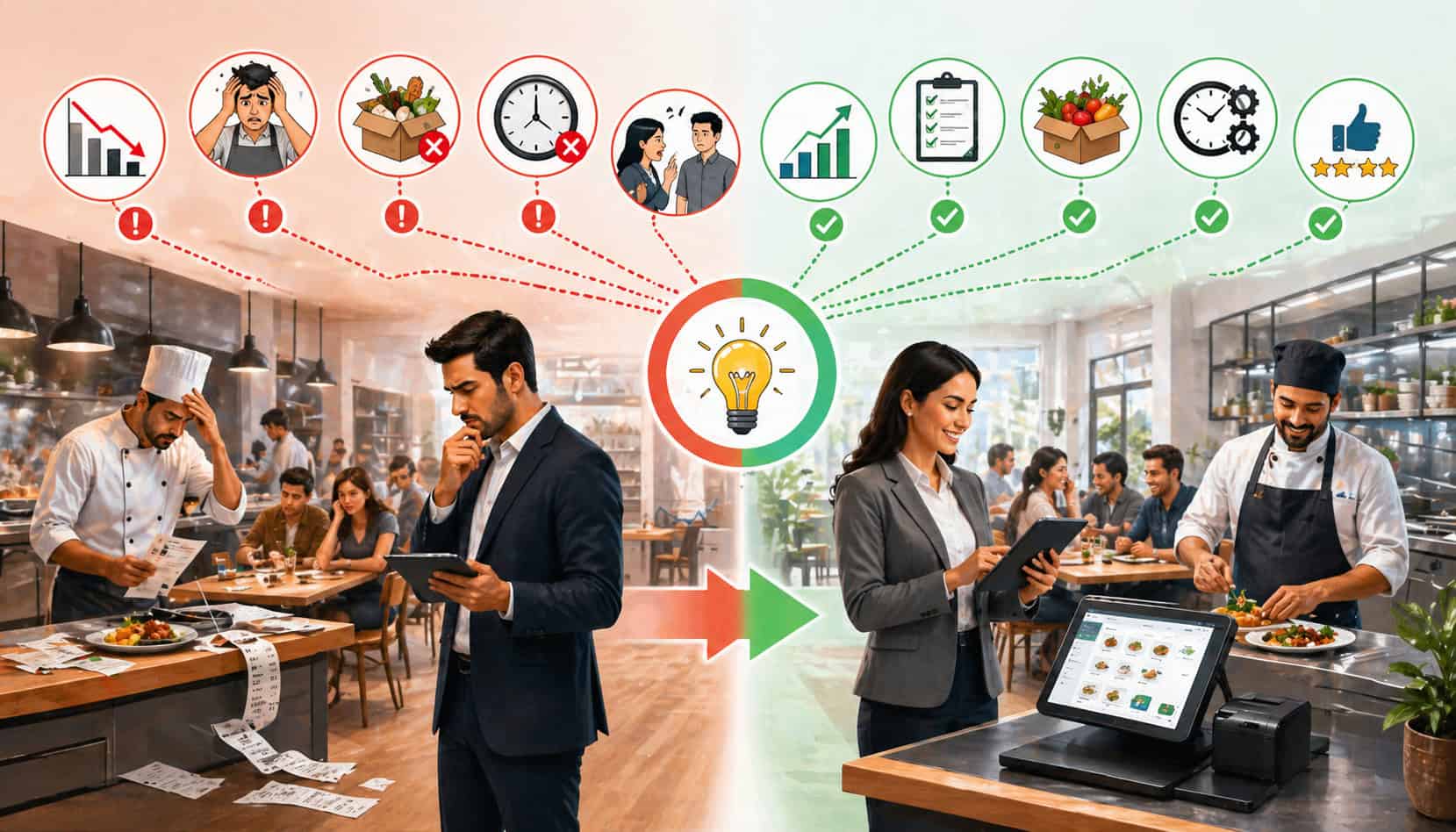
Restaurant operations involve many moving parts that must work together every day: staffing, purchasing, inventory, food prep, kitchen execution, service, cost control, compliance, and customer experience.
When one area breaks down, the impact often spreads quickly. A late delivery can disrupt prep. A short-staffed shift can slow service. An inaccurate inventory count can lead to stockouts, waste, and margin pressure.
Even well-run restaurants face daily operational challenges. The difference between a stressed operation and a resilient one is not whether problems happen. It is whether the restaurant has systems, training, accountability, and data to respond quickly.
The most common challenges in Restaurant Operations usually come from inconsistent processes, communication gaps, labor pressure, rising costs, disconnected tools, and unpredictable demand. These issues affect efficiency, profitability, staff morale, and guest satisfaction.
This guide breaks down the biggest restaurant operational challenges and provides practical restaurant operations problems and solutions that owners, general managers, kitchen managers, chefs, and food service operators can apply.
What Are the Most Common Challenges in Restaurant Operations?
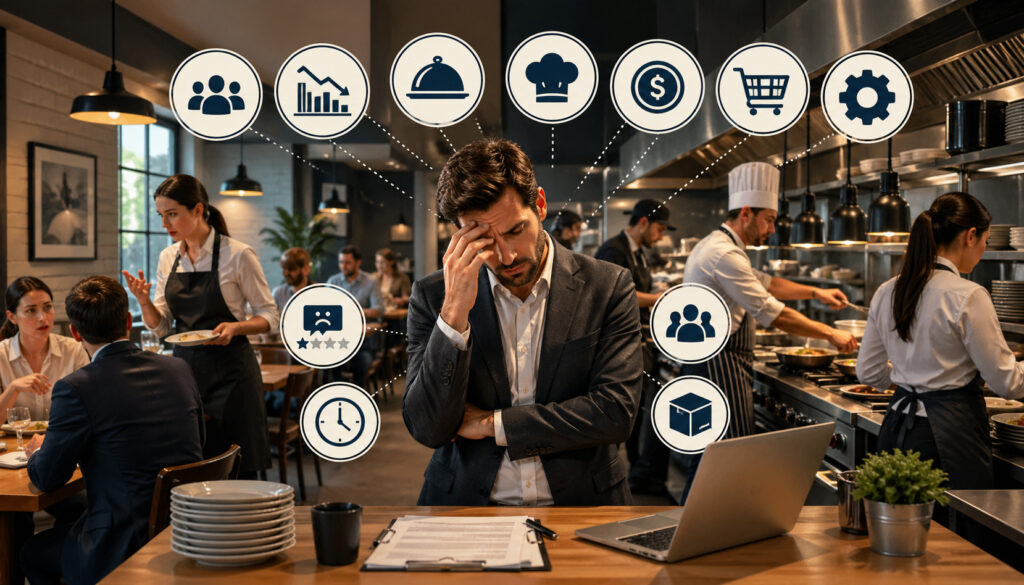
The most common challenges in Restaurant Operations are not isolated problems. They are connected issues that affect the entire business. Staffing challenges influence service speed. Inventory management issues affect food cost and menu availability.
Poor communication between front and back of the house creates order errors and guest complaints. Weak cost controls reduce profitability even when sales look strong.
Restaurant operational challenges usually fall into a few major categories:
- Labor and staffing
- Inventory accuracy and food waste
- Rising food costs
- Kitchen workflow and prep planning
- Communication between teams
- Service consistency
- Technology gaps
- Compliance and food safety
- Data visibility and reporting
Many restaurant operations management issues start because teams rely too heavily on memory, paper notes, informal habits, or last-minute decision-making. That might work for a small team during slow periods, but it becomes unreliable as volume grows, staff changes, or menu complexity increases.
Restaurant efficiency problems often appear during peak service. Orders pile up, tickets get missed, prep runs short, and managers spend the shift reacting instead of leading. Over time, these repeated issues create burnout, waste, customer dissatisfaction, and lower profit margins.
Solving food service operational issues requires more than telling staff to “work faster” or “pay closer attention.” Restaurants need clear standards, repeatable workflows, better forecasting, accurate inventory, trained teams, and connected systems. When each part of the operation has structure, managers can identify problems earlier and fix them before they damage service.
Labor and Staffing Challenges
Labor challenges in restaurants are among the most difficult operational problems because they affect every guest-facing and back-of-house function. A restaurant can have a strong menu, good location, and loyal customers, but if staffing is unstable, daily execution becomes unpredictable.
Common labor problems include staff shortages, high turnover, scheduling conflicts, inconsistent training, burnout, and uneven performance between shifts. These challenges in restaurant management become especially visible during busy periods, call-outs, seasonal demand changes, or when experienced employees leave.
High turnover is costly because every new hire requires recruiting, onboarding, training, supervision, and time to reach full productivity. When turnover is constant, managers spend more time filling gaps than improving operations. Existing employees also feel pressure when they must repeatedly train new team members while managing their own responsibilities.
Scheduling is another major source of restaurant workflow challenges. Understaffing leads to slower service, long wait times, rushed prep, and frustrated employees. Overstaffing increases labor costs and reduces profitability. The goal is not simply to schedule fewer people. The goal is to match labor to expected demand while protecting service quality.
Labor issues also affect consistency. One shift may execute perfectly while another struggles with ticket times, portioning, cleaning, or guest communication. This usually happens when expectations are unclear or training varies by manager.
Restaurants can reduce staffing pressure by building stronger systems around hiring, onboarding, scheduling, cross-training, performance feedback, and team culture. Labor will always require active management, but better structure makes the operation less fragile.
How to Improve Staff Retention and Training
Improving retention starts with making work more predictable, respectful, and organized. Employees are more likely to stay when they understand expectations, receive proper training, have reliable schedules, and feel supported by management.
A strong onboarding process is one of the best ways to reduce early turnover. New hires should not be thrown into a busy shift with vague instructions. They need a structured introduction to the restaurant’s menu, service standards, safety rules, cleaning procedures, communication expectations, and role-specific tasks.
Effective training should include:
- Written SOPs for key tasks
- Shadowing with experienced employees
- Checklists for opening, service, and closing
- Menu knowledge training
- Food safety and hygiene instruction
- Position-specific performance standards
- Follow-up reviews after the first few shifts
Cross-training is also valuable. When servers understand basic kitchen timing, they communicate better with guests. When prep cooks understand inventory procedures, waste and shortages decrease. When supervisors know multiple roles, they can support the team more effectively during rushes.
Retention also depends on culture. Staff members notice whether managers communicate respectfully, address problems fairly, and recognize good work. A supportive work environment does not mean ignoring poor performance. It means creating clear expectations and coaching people before problems become habits.
Using Scheduling Tools to Optimize Labor
Scheduling tools help restaurants align staffing with expected demand instead of relying on guesswork. Manual scheduling often creates conflicts, uneven shift distribution, unnecessary overtime, and coverage gaps.
These problems become more serious when managers are balancing full-time staff, part-time workers, availability changes, time-off requests, and peak service periods.
A good scheduling process uses sales trends, reservations, delivery volume, events, weather patterns, and historical traffic to plan labor needs. The goal is to staff each shift based on demand, not habit. A quiet weekday lunch may need fewer employees, while a high-volume dinner or catering day may need extra prep, expo, and support staff.
Scheduling software can help managers:
- Track employee availability
- Reduce last-minute conflicts
- Monitor overtime risk
- Forecast labor needs
- Communicate schedule changes quickly
- Improve shift coverage
- Compare labor cost against sales
It also improves transparency for employees. When staff can see schedules earlier, request changes, and receive updates, communication improves and call-outs may decrease.
Technology does not replace manager judgment, but it gives managers better information. Combined with clear policies and regular review, scheduling tools can reduce labor waste while protecting service standards.
Inventory Management and Food Waste Issues
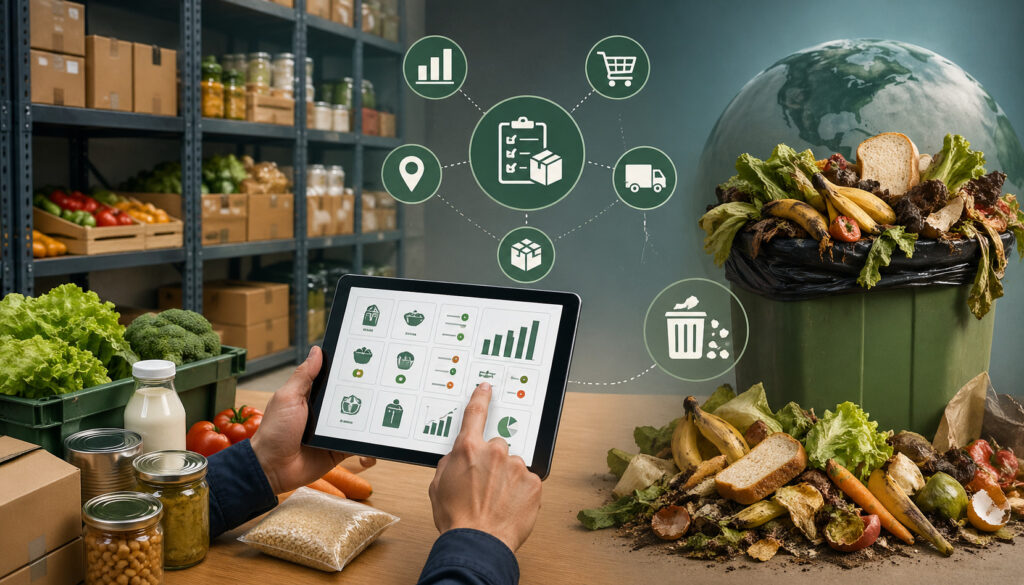
Inventory management issues are among the most common restaurant operations problems and solutions because they directly affect food cost, cash flow, menu availability, and waste. When inventory is inaccurate, managers cannot confidently answer basic questions: What do we have? What do we need? What is expiring soon? What is being wasted? What is missing?
Common inventory challenges include overordering, stockouts, spoilage, theft, shrinkage, inconsistent counts, supplier errors, and lack of real-time visibility. These food service operational issues often happen because inventory is tracked manually, updated too late, or managed differently by different people.
Overordering ties up cash and increases spoilage risk. Underordering causes menu outages and guest disappointment. Poor storage practices lead to expired products, cross-contamination risks, and unnecessary waste. Inconsistent portioning can make theoretical inventory very different from actual inventory.
Inventory problems also create stress for kitchen teams. If prep cooks discover missing ingredients during service, they must improvise. If chefs cannot trust stock counts, they may order defensively, which increases waste. If managers do not compare invoices against deliveries, supplier mistakes can go unnoticed.
Digital tools can help restaurants move away from disconnected spreadsheets and manual paper counts. For example, resources on cloud food inventory management explain how real-time tracking can support better stock control and reduce reliance on outdated manual processes.
| Challenge | Common Cause | Practical Solution |
| Overstocking | Ordering without accurate usage data | Use par levels, sales trends, and regular inventory counts |
| Stockouts | Poor forecasting or late ordering | Set reorder points and review upcoming demand |
| Spoilage | Weak rotation and storage practices | Use FIFO, date labeling, and daily checks |
| Shrinkage | Waste, theft, or unrecorded usage | Track variances and assign inventory ownership |
| Inaccurate counts | Manual errors or inconsistent procedures | Use standardized count sheets or digital inventory tools |
| High food waste | Overproduction or poor portion control | Track waste by item, shift, and reason |
| Supplier discrepancies | Invoices not checked against deliveries | Verify deliveries before accepting or approving invoices |
How to Reduce Food Waste
Reducing food waste starts with visibility. A restaurant cannot fix waste it does not measure. Waste should be tracked by item, quantity, reason, shift, and estimated cost. This helps managers identify whether waste comes from spoilage, overproduction, incorrect prep, returned dishes, trimming loss, or portioning errors.
FIFO is one of the simplest and most effective waste-control practices. First-in, first-out means older stock is used before newer stock. This requires proper labeling, organized storage, and daily checks. If employees cannot clearly see dates, products are more likely to expire unnoticed.
Portion control also matters. Small over-portions may seem harmless, but they can create major cost problems over hundreds or thousands of plates. Standardized recipes, portion tools, training, and line checks help reduce inconsistency.
Restaurants should also review prep levels. Over-prepping is often caused by fear of running out, but accurate sales history and par levels can reduce that risk. Prep should be based on demand patterns, not habits.
Helpful waste-reduction practices include:
- Date-labeling all prepped items
- Reviewing waste logs weekly
- Training staff on proper storage
- Using trim creatively where safe and appropriate
- Adjusting prep quantities based on sales trends
- Monitoring slow-moving ingredients
Improving Inventory Accuracy
Inventory accuracy depends on consistent counting, clear organization, and timely updates. If different managers count products differently, reports will not be reliable. For example, one person may count cases while another counts individual units. One may include open containers while another excludes them. These inconsistencies create misleading numbers.
Start by standardizing units of measure. Decide whether each item is counted by case, pound, ounce, bottle, bag, or each. Then make sure purchasing units, recipe units, and count units connect properly. This is especially important for recipe costing and food cost tracking.
Regular counts are essential. High-value or fast-moving items may need daily checks, while dry storage may be counted weekly. Counts should happen at the same time and under similar conditions when possible. This makes trends easier to compare.
Digital inventory tracking can improve accuracy by connecting counts, purchases, recipes, and usage. Guides on setting up kitchen inventory management can be useful for operators building a more structured process.
Supplier coordination also matters. Managers should compare deliveries against purchase orders and invoices before accepting them. Short shipments, substitutions, damaged goods, and price changes should be documented immediately.
Rising Food Costs and Profit Margin Pressure

Restaurant cost control has become one of the most important management priorities because small changes in ingredient prices can quickly affect profitability. A menu item that was profitable last month may lose margin if key ingredients increase in cost and pricing is not adjusted.
Rising food costs can come from supplier price changes, seasonal availability, delivery fees, inconsistent ordering, waste, theft, poor portion control, and inaccurate recipe costing. Many restaurants discover margin problems too late because they only review costs after financial reports are complete.
Profit margin pressure is especially difficult because operators must balance cost control with guest expectations. Raising prices too aggressively can hurt demand. Reducing portions without a clear strategy can damage trust. Buying cheaper ingredients may affect quality. The best solution is to manage costs with data, not guesswork.
Restaurants should understand the relationship between recipe cost, menu price, contribution margin, sales volume, and waste. A popular item is not always profitable. A high-margin item is not always valuable if it rarely sells. Menu decisions should be based on both profitability and popularity.
Food cost tracking tools can help restaurants monitor ingredient changes and recipe-level profitability. A practical resource on food cost tracking software explains how digital systems can connect purchases, recipes, inventory, and sales to provide better cost visibility.
Menu Engineering and Cost Control
Menu engineering helps restaurants make smarter pricing, promotion, and recipe decisions. It looks at two key factors: how profitable an item is and how often it sells. This helps managers identify which dishes to feature, reprice, improve, simplify, or remove.
Recipe costing is the foundation. Every menu item should have an updated recipe cost based on current ingredient prices and correct portion sizes. If recipes are outdated or informal, managers cannot accurately calculate margins.
Menu engineering can help identify:
- High-profit, high-popularity items to promote
- High-profit, low-popularity items to reposition
- Low-profit, high-popularity items to reprice or adjust
- Low-profit, low-popularity items to consider removing
Cost control does not always mean raising prices. Restaurants may improve margins by reducing waste, adjusting portion sizes carefully, changing plate composition, using seasonal ingredients, simplifying prep, or negotiating supplier terms.
Menu design also affects profitability. Item placement, descriptions, category structure, and server recommendations can influence what guests order. However, these tactics should support genuine value and quality, not hide poor pricing decisions.
Operators can also use guides on calculating food costs with cloud-based tools to build a more consistent approach to recipe costing and margin review.
Supplier Management Strategies
Supplier management is a major part of restaurant cost control. Many operators focus on menu prices but overlook purchasing discipline. Supplier pricing, delivery reliability, product quality, minimum order requirements, and substitution policies all affect operations.
A strong supplier strategy starts with tracking purchase trends. Managers should know which ingredients are rising in cost, which vendors are most reliable, and where substitutions are creating quality or consistency issues. Without purchase history, negotiations become difficult.
Restaurants should avoid depending too heavily on one supplier for critical items. Diversifying suppliers can reduce risk when products are unavailable, prices spike, or delivery problems occur. However, too many suppliers can also create complexity, so the goal is balanced flexibility.
Useful supplier management practices include:
- Comparing prices on high-volume ingredients
- Reviewing invoices for unexpected increases
- Confirming delivery accuracy
- Tracking supplier substitutions
- Negotiating based on order volume
- Setting quality standards for key products
- Maintaining backup suppliers for critical items
Communication is also important. Suppliers should understand the restaurant’s quality expectations, delivery windows, and substitution rules. Managers should document recurring problems and review them regularly.
Communication Gaps Between Front and Back of House
Communication gaps between front and back of house are a major source of restaurant workflow challenges. When servers, hosts, expos, cooks, bartenders, and managers are not aligned, the guest experience suffers.
Orders may be entered incorrectly, allergy notes may be missed, ticket times may increase, and guests may receive inconsistent information.
Front-of-house teams manage guest expectations. Back-of-house teams manage execution. Both sides depend on accurate, timely communication. If the kitchen is running behind but servers are not informed, guests become frustrated.
If servers modify dishes without clear rules, the kitchen becomes overwhelmed. If hosts seat too many tables at once, both service and kitchen timing can collapse.
Miscommunication often comes from unclear processes. For example, how should a server communicate an allergy? Who tells the dining room when an item is unavailable? How are remake orders prioritized? Who approves special requests? What happens when a delivery order conflicts with dine-in volume?
These questions should not be answered differently on every shift. Restaurants need clear communication standards and escalation paths.
Technology can help, but tools alone do not solve communication problems. A kitchen display system, POS notes, shared task lists, and manager logs are only effective when staff are trained to use them consistently.
Strong communication improves speed, accuracy, morale, and accountability. It also reduces conflict between teams because expectations are visible and shared.
Improving Kitchen and Service Communication
Improving kitchen and service communication starts with standardizing how information moves. Verbal communication alone is risky during busy service because people are distracted, noise levels are high, and memory is unreliable. Important information should be visible in the systems and workflows teams already use.
Kitchen display systems can reduce ticket confusion by showing orders clearly, tracking timing, and organizing priorities. POS modifiers should be standardized so the kitchen receives consistent instructions. Allergy notes, seat numbers, coursing, and special requests should follow strict rules.
Shared task lists can help managers coordinate side work, prep needs, cleaning, and shift handoffs. A manager log can capture issues that need follow-up, such as customer complaints, equipment problems, supplier mistakes, or staffing concerns.
Restaurants should also clarify communication roles. For example:
- Servers communicate guest needs through the POS and expo.
- Expo manages ticket flow and quality checks.
- Kitchen leads communicate delays or shortages.
- Managers handle guest recovery and shift-wide decisions.
This reduces random interruptions and keeps information flowing through the right channels.
Training should include communication scenarios. Staff should practice how to handle allergies, remakes, long waits, unavailable items, and guest complaints.
Customer Experience and Service Consistency Challenges
Customer service challenges in restaurants are often the visible result of deeper operational problems. Guests notice long wait times, inconsistent food quality, order mistakes, slow refills, unavailable menu items, and unhelpful responses to complaints.
They may not see the inventory issue, staffing shortage, prep mistake, or communication gap behind the problem, but they feel the impact.
Service consistency is difficult because restaurants depend on many people performing many tasks correctly under pressure. A guest may have an excellent experience on one visit and a disappointing one on the next if standards are not consistent.
Common customer experience problems include:
- Long waits for tables or food
- Incorrect orders
- Inconsistent portions or presentation
- Poor handling of allergies or modifications
- Slow complaint resolution
- Unclear communication about delays
- Negative online reviews
- Uneven hospitality between shifts
The solution is not simply telling staff to “give better service.” Operators need service standards, training, quality checks, and accountability. Managers should define what good service looks like at each step, from greeting to payment.
Customer expectations are also shaped by convenience. Guests expect accurate orders, fast communication, flexible ordering options, and consistent quality across dine-in, pickup, and delivery. This adds complexity because restaurants must manage multiple service channels without letting one damage another.
Standardizing Service and Quality
Standardizing service and quality means creating repeatable expectations for both guest interaction and food execution. Without standards, each employee relies on personal judgment, which creates inconsistency.
Service SOPs should define key moments, including greeting times, order-taking expectations, check-back timing, complaint escalation, payment handling, and closing interactions. These standards should be specific enough to train and measure.
Food quality standards should include plating guides, portion sizes, temperature expectations, garnish requirements, and acceptable presentation. Photos can be helpful for training because they show what “correct” looks like.
Quality checks should happen before food reaches the guest. Expo roles are especially important because they act as the final checkpoint between kitchen execution and customer experience. Expo should verify accuracy, presentation, temperature, modifiers, and timing.
Accountability matters, but it should be fair. If mistakes happen because standards are unclear, managers must fix the process first. If standards are clear and training is complete, performance conversations become more objective.
Restaurants should also use guest feedback as operational data. Reviews, surveys, complaints, and compliments can reveal patterns. A single bad review may be an outlier. Repeated comments about slow service or inconsistent food point to a process issue.
Technology and System Integration Challenges
Technology can solve many restaurant operations management issues, but it can also create new problems when systems are disconnected. Many restaurants use separate tools for POS, inventory, scheduling, accounting, reservations, delivery, payroll, and reporting. If these systems do not communicate, managers spend too much time reconciling data manually.
Disconnected systems create several problems. Sales data may not update inventory. Labor reports may not connect to revenue. Vendor invoices may not feed into food cost calculations. Menu changes may need to be entered in multiple places. This creates delays, duplicate work, and reporting errors.
Technology challenges also come from poor implementation. A tool may be powerful, but if staff are not trained or workflows are not updated, adoption will be weak. Managers may keep using spreadsheets because the new system feels confusing or incomplete.
Another issue is choosing tools without clear goals. Restaurants should not adopt software just because it is popular. They should identify the operational problem first, then choose technology that solves it. For example, if the main problem is inventory accuracy, the priority should be stock tracking, recipe costing, and supplier management. If the main problem is labor control, scheduling and labor forecasting matter more.
Technology should simplify operations, not add complexity. The best systems reduce manual work, improve visibility, and help managers make faster decisions.
Benefits of Integrated Restaurant Systems
Integrated restaurant systems connect important operational data so managers can see the full picture. When POS, inventory, purchasing, scheduling, and reporting work together, restaurants can make decisions based on current information instead of delayed reports.
For example, POS sales data can help forecast prep needs. Inventory data can support smarter purchasing. Recipe costing can reveal menu profitability. Scheduling data can show labor cost as a percentage of sales. Supplier data can highlight price changes and ordering patterns.
Integrated systems can improve:
- Inventory accuracy
- Food cost visibility
- Labor planning
- Menu profitability analysis
- Ordering efficiency
- Waste tracking
- Manager reporting
- Multi-location consistency
Digital kitchen management also helps replace scattered paper logs with more reliable task tracking, safety records, and operational checklists. A useful guide on digitalizing kitchen records and workflows explains how digital systems can support logs, food safety tasks, prep discipline, equipment care, and daily execution.
The biggest benefit is not just convenience. It is better decision-making. When managers can see accurate data quickly, they can act before small problems become expensive.
Compliance, Safety, and Hygiene Challenges
Compliance, safety, and hygiene are critical food service operational issues because they affect guests, employees, reputation, and business continuity. Restaurants must manage food handling, storage, temperature control, cleaning, allergen procedures, pest prevention, equipment maintenance, and employee hygiene every day.
The challenge is consistency. Food safety standards may be clear, but busy shifts create pressure. Employees may skip logs, rush cleaning tasks, forget temperature checks, or misunderstand allergen procedures. A single missed step can create serious risk.
Common compliance challenges include:
- Incomplete temperature logs
- Poor labeling and date marking
- Cross-contamination risks
- Inconsistent handwashing
- Improper cooling or reheating
- Missed cleaning tasks
- Weak allergen controls
- Lack of documentation
- Unclear responsibility for inspections
Managers should make compliance part of the daily workflow, not a separate activity that only matters before inspections. This means assigning ownership, using checklists, verifying completion, and correcting issues immediately.
Training is essential. Staff should understand not only what to do, but why it matters. For example, proper cooling procedures are not paperwork; they protect guests. Allergen communication is not optional; it can prevent serious harm.
Documentation also matters. Logs, checklists, corrective actions, and maintenance records help managers prove that procedures are being followed. Digital records can make this easier by reducing lost paperwork and improving visibility.
Best Practices to Overcome Restaurant Operations Challenges
Overcoming Challenges in Restaurant Operations requires a structured approach. Restaurants do not need to fix everything at once, but they do need a repeatable way to identify problems, prioritize improvements, and measure results.
Start with regular operational audits. Review labor, inventory, food cost, service speed, customer complaints, waste, and compliance. Audits should not feel like punishment. They are a way to see what is working and what needs attention.
Next, standardize key processes. SOPs should exist for opening, closing, prep, receiving deliveries, inventory counts, cleaning, guest complaints, allergy handling, and cash management. When procedures are written and trained, managers can hold teams accountable more fairly.
Training should be continuous. Restaurants change constantly: new menu items, new employees, new suppliers, new technology, and new customer expectations. A one-time training session is not enough. Managers should coach during shifts, review mistakes constructively, and refresh standards regularly.
Data-driven decisions are also essential. Instead of relying only on instinct, managers should review reports for sales trends, labor cost, food cost, waste, inventory variance, ticket times, and guest feedback. Data does not replace experience, but it helps managers see patterns they might otherwise miss.
Best practices include:
- Review key numbers weekly
- Use checklists for repeatable tasks
- Track waste and inventory variance
- Hold short pre-shift meetings
- Train managers to coach consistently
- Standardize recipes and portions
- Compare labor schedules to demand
- Document recurring issues
- Use technology where it reduces manual work
- Follow up on problems quickly
Continuous improvement is the goal. A restaurant that improves one process each week can make major progress over time.
Common Mistakes Restaurant Operators Should Avoid
Many restaurant operations problems become worse because managers respond reactively. They fix the immediate issue but never address the system behind it. For example, if the kitchen runs out of a key ingredient, a manager may rush to buy more. That solves the moment, but not the forecasting, ordering, or inventory process that caused the shortage.
One common mistake is ignoring data. Operators may look at sales but not food cost, labor cost, waste, or item-level profitability. Revenue can hide operational weakness. A busy restaurant can still lose money if costs are uncontrolled.
Another mistake is undertraining. New employees may be expected to learn by watching others, but this creates inconsistency. If the person they shadow has bad habits, those habits spread. Training should be intentional, documented, and verified.
Restaurants also struggle when processes depend too heavily on one experienced employee. If only one manager knows how to order, count inventory, or handle vendor issues, the operation becomes vulnerable. Cross-training and documentation protect the business.
Common mistakes include:
- Making decisions without current data
- Using outdated recipes for costing
- Ignoring small waste patterns
- Letting each manager run shifts differently
- Failing to document SOPs
- Overcomplicating menus
- Not reviewing supplier pricing
- Treating technology as a quick fix
- Waiting too long to address poor performance
- Responding to reviews without fixing root causes
Avoiding these mistakes requires discipline. Strong restaurant operations are built through daily habits, not occasional major changes.
FAQs
What are the biggest challenges in restaurant operations?
The biggest challenges in restaurant operations include labor shortages, high staff turnover, rising food costs, inventory management issues, food waste, inconsistent service, communication gaps, technology problems, and compliance pressure. These issues often affect each other, so restaurants need strong systems, training, and data-driven processes to manage them effectively.
How can restaurants reduce operational problems?
Restaurants can reduce operational problems by standardizing procedures, improving staff training, tracking key performance metrics, using accurate inventory systems, and holding regular management reviews. Checklists, pre-shift meetings, waste tracking, recipe costing, and schedule reviews can help prevent issues before they affect service.
What causes inefficiencies in restaurant management?
Inefficiencies in restaurant management are often caused by unclear processes, poor communication, disconnected systems, weak training, inaccurate data, and reactive decision-making. When workflows are not standardized, managers and staff spend more time fixing problems than preventing them.
How can technology improve restaurant operations?
Technology can improve restaurant operations by reducing manual work, improving visibility, connecting systems, and helping managers make faster decisions. Integrated tools can support inventory tracking, recipe costing, labor scheduling, purchasing, kitchen logs, and reporting.
What are common inventory challenges in restaurants?
Common inventory challenges in restaurants include overordering, stockouts, spoilage, inaccurate counts, shrinkage, poor storage, supplier errors, and lack of real-time tracking. Restaurants can improve inventory control through par levels, FIFO rotation, regular counts, delivery checks, waste logs, and digital inventory tools.
How can restaurants control food costs?
Restaurants can control food costs by tracking ingredient prices, costing recipes accurately, monitoring waste, standardizing portions, reviewing supplier invoices, and using menu engineering. Regularly reviewing high-cost ingredients and updating recipe costs can help protect profit margins.
Why is staff turnover high in restaurants?
Staff turnover is often high in restaurants because the work can be demanding, schedules may be inconsistent, training may be limited, and workplace culture may vary by manager. Restaurants can improve retention with better onboarding, fair scheduling, clear expectations, supportive leadership, and growth opportunities.
How can restaurants improve customer experience?
Restaurants can improve customer experience by standardizing service, improving order accuracy, reducing wait times, maintaining food quality, training staff, and responding quickly to complaints. A consistent guest experience depends on both front-of-house hospitality and back-of-house execution.
Conclusion
Challenges in Restaurant Operations are part of running a food service business, but they do not have to control the operation. Labor pressure, inventory issues, food cost increases, communication gaps, compliance demands, and customer service challenges can be managed with better systems, stronger training, clearer workflows, and data-driven decisions.
The key is to move from reactive management to proactive operations. That means tracking problems, identifying root causes, standardizing processes, training teams consistently, and using technology where it improves accuracy and efficiency.
When restaurant operators solve operational challenges, the benefits reach every part of the business. Staff work with less confusion. Kitchens run more smoothly. Guests receive more consistent service. Managers make better decisions. Costs become easier to control.
A restaurant does not become efficient by accident. It becomes efficient through daily discipline, clear expectations, and continuous improvement. By addressing restaurant operational challenges one system at a time, operators can build stronger teams, smoother service, better customer experiences, and healthier profitability.