
By Ethan Walker August 25, 2026
Every February, the same scene plays out in restaurants across the country. A manager digs through a year of sales reports, tip logs, and payroll files. The IRS deadline is days away. The numbers don’t quite line up. Sound familiar?
Form 8027 is a requirement if you operate a large food or beverage business. It is an annual report to the IRS for tips received and tips allocated. Filing this is the easy part. Gathering the information is the challenge. This form can become a source of stress and penalty risk if your records are poor. When your information is organized, this form is a breeze to file.
This guide prepares your records for Form 8027. You will learn the filing requirements, what records are necessary, an explanation of the 8% allocation rule, and how to build an organized system for an easier tax season.
What Is Form 8027 and Who Must File It?
Form 8027 is officially called the Employer’s Annual Information Return of Tip Income and Allocated Tips. The IRS uses it to track the tips that flow through large food and beverage businesses each year. The form also helps you figure out whether you owe your staff any allocated tips.
Not every restaurant has to file. Your establishment qualifies as a “large food or beverage establishment” when a particular set of circumstances all apply. Your operation needs to be in one of the 50 states or the District of Columbia. The establishment needs to serve food or beverages to be consumed on the premises, which would eliminate the vast majority of fast food operations where the customer orders and pays for the meal before taking a seat. It also needs to be customary to tip the employees of your food and beverage business, and you need to have typically employed more than 10 employees on an average business day during the preceding calendar year.
That employee count trips people up. It is the total number of employees, not just the servers and tipped employees. Anyone with a 50% or greater ownership interest in the business is not an employee for this purpose. If you have more than one location, each location that meets this test needs to file a separate Form 8027. For example, a casino with a restaurant, a café, a bar, and a showroom could file four separate returns for the entities that meet the threshold.
Why Data Readiness Makes or Breaks Your Filing
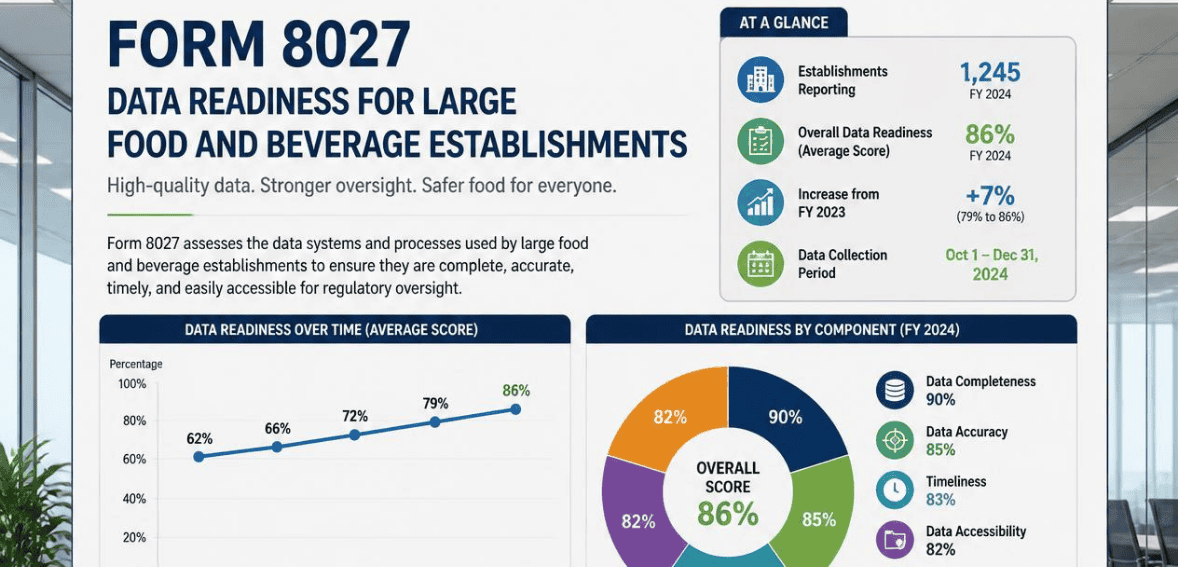
Here is the truth most compliance guides skip. Form 8027 is only as accurate as the records feeding it. The form has just a handful of lines. Each line depends on clean, year-long data that many restaurants never bother to organize until the last minute.
When your data is disorganized, three main issues arise. First, your reported tips may appear unreasonably low, resulting in an automatic tip allocation. Second, your gross receipts may be confused by service charges and non-tippable sales. Third, your establishment numbers may not agree with your payroll and W-2 records. Each of these problems may result in a penalty from the IRS or correspondence from the agency about your case.
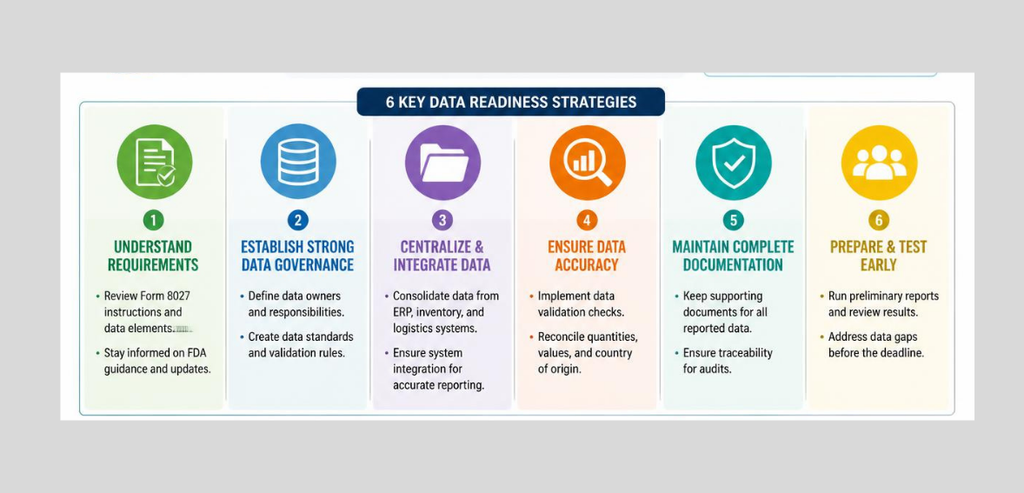
With good data, this entire situation is a lot easier. When you capture the correct data throughout the year, you can verify it every month rather than scrambling to do it last minute in February. This makes the filing of the form a lot easier when the time comes.
The Form 8027 Restaurant Records You Need to Gather
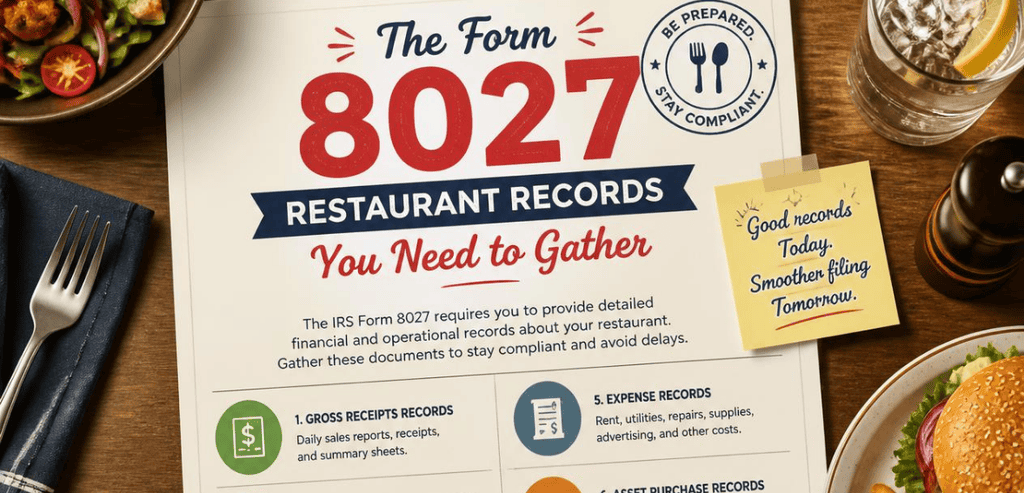
Strong Form 8027 restaurant records are the foundation of an accurate return. You need three broad categories of information, and each one comes from a different corner of your operation. Let’s break them down.
Gross Receipts and Sales Data
Your gross receipts are your total sales on food and beverages for which tipping is customary. Gross receipts are not your total sales. You should distinguish between gross receipts and non-tippable, or “nonallocable,” receipts. Non-tippable receipts include takeout sales, sales with a service charge of 10% or more, or other sales transactions where tipping is not customary. Additionally, even if you do not charge customers for food and beverages, gross receipts do include complimentary food and beverages. Therefore, you must account for those.
This is easiest to track through your point-of-sale system. A good POS distinguishes takeout and dine-in sales and marks service charges automatically. If your system is that good, then you have most of the gross receipts information available to you.
Charged Tips and Charge Receipts
Charged tips are the tips your customers add to credit and debit card transactions. Your POS or payment processor captures these automatically. You will report the total charged tips for the year and the total sales receipts that showed a charged tip. These figures matter because they support the tip totals your staff report.
Employee-Reported Tips
Here is where the majority of restaurants struggle. Your employees are legally obligated to report their tips to you by the 10th of each following month. No system captures tips given to employees in cash. Without accurate reporting from employees, Form 8027 numbers will be incorrect from the beginning.
When it comes to employees who receive tips, the IRS differentiates between directly tipped employees and indirectly tipped employees. Servers and bartenders are examples of directly tipped employees. Bussers and food runners are examples of indirectly tipped employees and receive their tips from a communal tip pool. You report information for both classes of employees, and for directly tipped employees, you report the total number of employees. When tips are pooled and the business makes the distribution, the difference between the two groups tends to disappear and you concentrate on the total tips paid out by the business through the payroll.
Understanding the 8% Tip Allocation Rule

Here is the rule regarding Form 8027. If reported employee tips amount to less than 8% of gross receipts, the IRS assumes tips are underreported. Consequently, the IRS requires you to allocate tips to your employees based on the difference. Allocated tips are reported on Form 8027 and on Box 8 of the employee’s W-2.
While Form 8027 appears complicated, relief is on the way for many business owners. You do not withhold income tax or FICA on allocated tips. Withholding is only done for reported tips. As far as W-2s are concerned, allocated tips are informational and do not represent a payroll deduction.
Tips can be allocated using one of three methods. One method is the gross receipts method, which allocates the shortfall based on the employee’s share of sales. Another method, the hours-worked method, is only available to establishments with fewer than 25 full-time equivalent employees, and allocates based on the employee’s hours worked. The third method is a good-faith agreement, which can be established by obtaining a written agreement from at least two-thirds of the tipped employees. Consistently reporting tips in excess of 8% can eliminate the need for allocation, and is one of the reasons why it is beneficial to report tips on a monthly basis.
E-Filing Rules You Can’t Ignore
The way you submit Form 8027 has changed, and this catches many restaurants off guard.
The IRS FIRE System
FIRE stands for the IRS system for Filing Information Returns Electronically. To access this system, you need a TCC (Transmitter Control Code). To obtain a TCC, new filers must verify their identity with ID.me and complete the application process. This is not an instantaneous process, so it is unwise to wait until the last minute to complete this.
The key number to observe is the e-filing threshold, which is 10 information returns filed in a calendar year. If you file 10 or more information returns of any type, you need to file electronically. This is an aggregate number for all returns filed, which includes W-2s and 1099s, and is not limited to Form 8027 filings. Given that most qualifying restaurants file well over 10 W-2s during a year, they are essentially required to e-file. If you file on paper and submit more than one Form 8027, you will attach a Form 8027-T as a transmittal. E-filers will not need to complete the 8027-T form.
Key Deadlines and Extensions
It’s easy to keep track of returns when you know the two important dates. Paper returns must be filed by the end of February. For electronic returns, the deadline is the last day of March. Due dates that land on a weekend or holiday get pushed to the next weekday. Because of this rule, e-filed returns for the 2026 calendar year must be submitted by March 31, 2027, and the paper returns must be filed by March 1, 2027.
To get an extra month to file returns, you can submit Form 8809 to request an automatic deadline extension. However, this form must be filed by the initial due date of the return. Also, always keep records for at least three years after the due date of your return. Those records will be proof of your reported and allocated tips to the IRS if they ask you to prove those tips.
Building a Repeatable Data-Readiness Workflow
The aim is to do the least amount of work to make tax season the most boring time of the year. This happens when data readiness is the expectation.
To capture cash tips, program the POS to make tipped employees enter their cash tips before clocking out. This is the final step because card tips are already captured. To avoid generous allocations come February, monitor your tips and gross receipts for the whole year. You know you’re doing something right when your tips are consistently at the 8% threshold.
Tax season can be made easier by assigning ownership to confirm establishment numbers and consistency with payroll and W-2 records. This is especially beneficial for operators with multiple establishments. Inconsistent work papers and fluctuating establishment numbers cause bottlenecks in the filing process. A little consistency throughout the year makes tax season a little easier.
Conclusion
Form 8027 rarely fails because the form is hard. It fails because the data behind it is not ready. When you treat tip reporting as a year-round habit rather than a February emergency, everything changes. Your gross receipts are clean. Your employee tip reports are complete. Your 8% math checks out. Your establishment numbers match your payroll.
Get your Form 8027 restaurant records in order now, and the filing becomes a formality. Set up your POS to capture tips at the source, reconcile monthly, secure your TCC early, and mark the deadlines on your calendar. Data readiness is not just about avoiding penalties. It is about running a tighter, calmer, more compliant operation all year long. Start building that system today, and next tax season will thank you.
Frequently Asked Questions
Do I have to file Form 8027 if my restaurant has fewer than 10 employees?
No. Form 8027 applies only to large food or beverage establishments that normally employed more than 10 employees on a typical business day in the prior year, alongside the other qualifying conditions. Smaller restaurants are not required to file, though they still must handle regular tip reporting and withholding.
What happens if my employees report less than 8% of gross receipts in tips?
You must allocate the difference between reported tips and 8% of gross receipts among your tipped employees. These allocated tips appear in Box 8 of each worker’s W-2. You do not withhold taxes on the allocated amount, since it is an information figure rather than actual paid wages.
Can I still file Form 8027 on paper?
Only if you file fewer than 10 total information returns for the year across all types, including W-2s and 1099s. Because most qualifying restaurants file more than 10 W-2s alone, electronic filing through the IRS FIRE system is mandatory for them. Apply for your Transmitter Control Code early to avoid a last-minute scramble.
How long should I keep my Form 8027 restaurant records?
Keep all supporting records for at least three years after the due date of the return. That includes sales data, charge receipts, employee tip reports, and your allocation calculations. These documents protect you if the IRS ever questions your reported or allocated tips.