
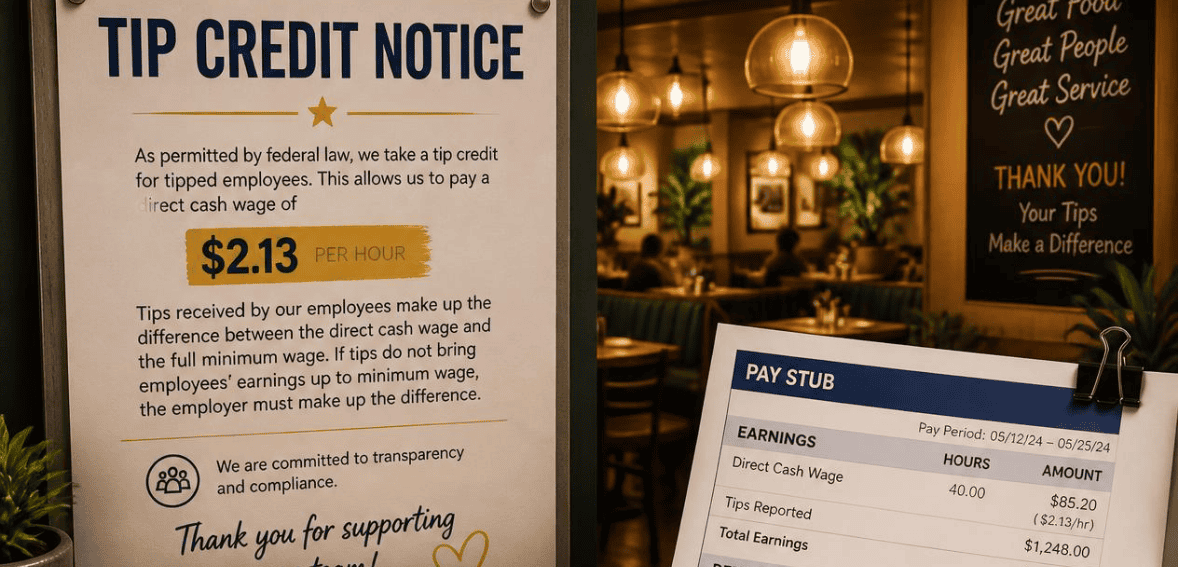
Most restaurant owners think a tip credit saves them money. It does. But it also creates a paper trail that has to match. One missing signature. One number that doesn’t line up. That’s often all it takes for a wage claim to succeed.
There’s no such thing as a free tip credit. Several requirements come with the credit, a few of which are more troublesome for the operator than the rest, specifically the tip credit notice and the payroll record associated with it. If the credit notice and the payroll record do not match, the credit is invalid. The consequences of this are that you must pay back wages, in addition to damages and attorney’s fees.
In this guide you will find how to properly draft a tip credit notice, what records you are legally required to keep, and how to align both to avoid any surprises in the event of an audit or lawsuit.
What Is the Tip Credit, in Plain Terms?
The tip credit allows you to use tips to help meet the minimum wage obligation. The federal Fair Labor Standards Act (FLSA) allows employers to pay a tipped employee a cash wage of only $2.13 per hour. The federal minimum wage is $7.25 per hour. The tip credit is the difference between $7.25 and $2.13, which comes to a maximum of $5.12 per hour.
However, there is a requirement. The total of employee tips and the cash wage must equal at least the minimum wage of $7.25 per hour for each hour of work in the pay period. If at any time the tips for a particular pay period are insufficient to meet the minimum wage, you are legally required to pay the employee the difference.
That test is only as reliable as the tip figure feeding it, and the tip figure comes from the point of sale, not from payroll. If the register is not capturing declared cash tips, routing card tips to the right server, and closing each shift with a clean per-employee total, the payroll record inherits the gaps — and an auditor will trace the notice back to a number nobody can reproduce. Getting restaurant tip management configured correctly at the POS is the upstream half of the compliance this guide describes.
A worker only qualifies as a “tipped employee” if they customarily and regularly earn more than $30 a month in tips. Servers and bartenders usually clear that bar. A dishwasher does not.
What the Tip Credit Notice Must Include
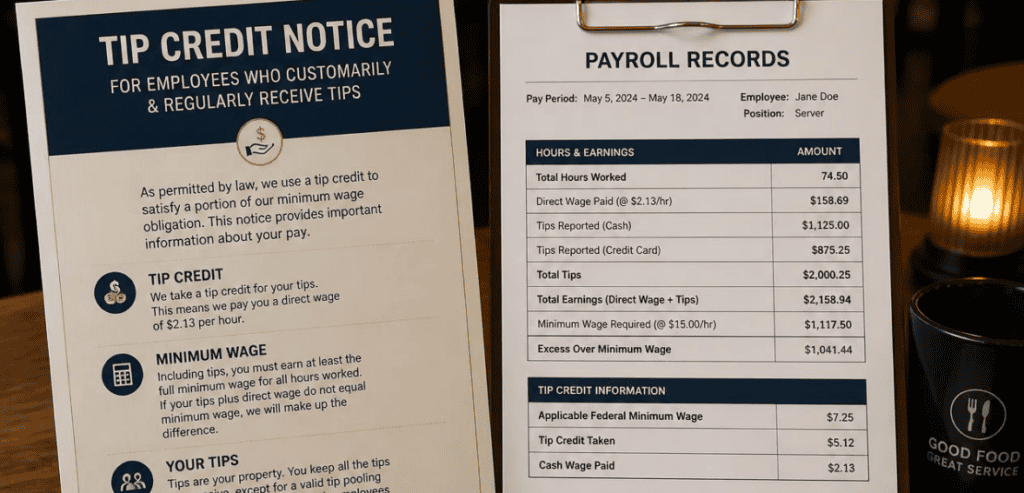
You cannot take the tip credit unless you tell the employee first. This is the tip credit notice. It has to happen before you apply the credit, not after. The notice can be verbal or in writing under federal law, but writing is far safer.
29 CFR 531.59(b) details what the written notification must include. You must inform the employee of their cash wage. You must inform the employee of the additional amount you are claiming as a tip credit. You must state that the tip credit will not exceed the amount of tips received by the employee. You must inform the employee that all tips are retained by the employee, unless a valid tip pooling arrangement is in place for employees who typically receive tips. You must also inform the employee that the tip credit applies only when these conditions are satisfied.
If you miss any of the above elements, the notice is deficient, and consequently the tip credit is also null. This means you are obliged to pay the employee the full wage instead of $2.13.
As many business owners know, verbal notification is legally sufficient; however, it is very difficult to substantiate. Your employee’s testimony will most likely carry more weight than yours. Therefore, it is highly advisable to prepare a written notice and have the employee date and sign it. The notice should be filed in the employee’s payroll or personnel file. This is the best defensive approach to the situation.
Payroll Records Restaurants Must Keep for Tipped Employees

The tip credit notice is only half the compliance picture. The other half is your payroll records. Federal rule 29 CFR 516.28 sets extra recordkeeping duties for any employer taking a tip credit.
You need to mark all tipped workers on your pay records. You also need to log the weekly or monthly amount of tips each worker reports. Many restaurants do this via IRS Form 4070. You also need to document the wage increase due to the tip credit. You also need to notify the employee in writing each time you change the hourly tip credit.
You need to keep all the supplemental records that go along with the basic payroll data. This includes records of each employee’s hours worked, their daily and weekly pay, gross wages, deductions, and net pay.
For tipped employees, add the supplemental records for the tips and the tip credit. You need to maintain these records for a minimum of three years. Some states have a longer time period. New York, for example, has a time period of six years. Keeping records for less time than required undermines your ability to defend yourself.
Why Reconciling the Notice and the Records Matters
Here’s where restaurants get burned. The notice says one thing. The payroll records say another. A plaintiff’s attorney will find that gap in minutes.
Say your tip credit notice includes a $5.12 credit, but your payroll system applied a $5.50 credit for three months without notice. Dangerous game. That means you either paid an employee less than the lawful cash wage, or you claimed a greater credit than the notice authorized. Either way, the credit is in serious jeopardy.
Consider this scenario. Say a server made less than $7.25 in a combined pay amount due to a lack of tips during a slow January. If you also failed to make a top-up payment to that employee, you’re looking at a textbook violation of the minimum wage law. A violation of this nature would be readily apparent as the employee’s pay records would reflect the failure to comply with minimum wage laws.
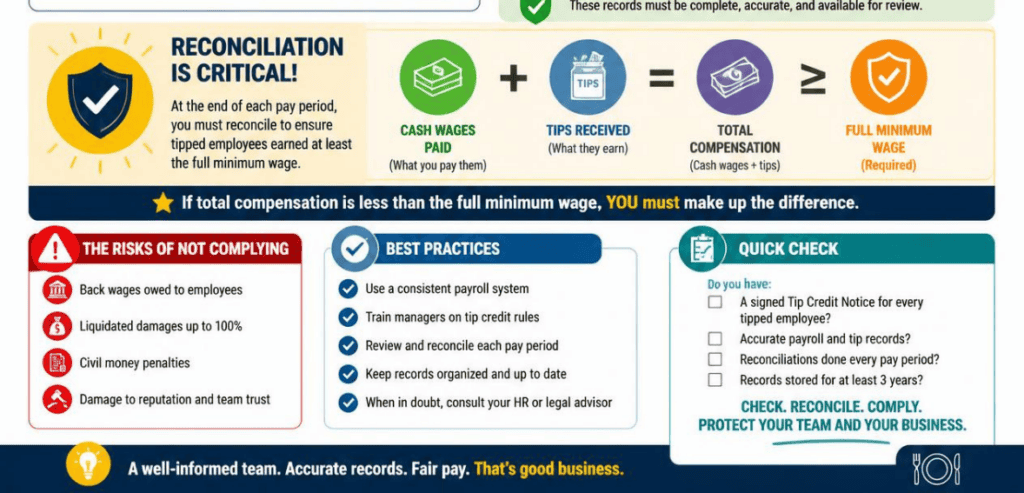
To reconcile means that each pay period, verify that the cash wage on the notice is the same as the cash wage on the paystub, that the tip credit claimed is not greater than the tips reported, and that the combined total is equal to the minimum wage. If the three are aligned, the tip credit is retained.
U.S. Department of Labor
The Wage and Hour Division of the U.S. Department of Labor (DOL) is in charge of enforcing the FLSA. The DOL also offers materials and guidance on the tip credit and tip pooling regulations as well as the applicable recordkeeping regulations. Every restaurant should evaluate itself against the DOL’s guidance. In addition, you can find the DOL’s official tipped employees’ regulation, as well as the official notice requirement, in the Electronic Code of Federal Regulations. In circumstances where federal law and state law differ, the law that is more favorable/beneficial to the employee will govern.
The Dual Jobs Rule Changed, and It Affects Your Records
For a few years, restaurants tracked the “80/20/30” rule. That rule limited how much non-tipped side work a tipped employee could do while still on the tip credit. Rolling silverware, prepping garnishes, and deep cleaning all counted as non-tipped work.
The rule has been eliminated at the federal level. The Fifth Circuit vacated the DOL’s 2021 rule nationwide on August 23, 2024 in Restaurant Law Center v. DOL, then clarified the scope of that vacatur in a revised opinion on October 29, 2024. The DOL formally withdrew the rule on December 17, 2024, reinstating the simpler 1967 dual jobs regulation.
How does this impact your records? Federally, you do not need to record “side-work” minutes to preserve the tip credit as the now vacated rule required. But don’t become complacent yet. New York and some other states still have their own “side-work” provisions. For example, the New York employer loses the tip credit for each day the employee spends more than 20% of the work shift or more than two consecutive hours performing duties that are not tipped. Therefore, you still need to keep records to comply with the state laws where they are required.
State Rules Can Override the Federal Tip Credit
The federal tip credit is a floor, not a ceiling. Many states go further.
Some states ban the tip credit entirely. California, Oregon, Washington, Montana, Nevada, Alaska, Minnesota, and a handful of others require the full state minimum wage in cash, with no tip offset. There are states, like Arizona and New York, that allow a partial credit, but have a cash wage greater than $2.13.
New York has additional requirements under their Wage Theft Prevention Act for written notice. Tipped employees must be given a written notice at the time of hire and each time their rate is changed. The notice must state the employee’s regular rate of pay, the overtime rate, the cash wage paid, and the tip credit claimed. Written notice must be signed by the employee and retained for 6 years. Each time a written notice is not in compliance, employers face a fine for each week the violation occurs in addition to losing the tip credit.
You must become familiar with state and local laws to avoid the federal gaps that exist. Compliance with the FLSA does not guarantee a notice will be compliant with your state laws.
A Simple Reconciliation Routine That Keeps You Compliant
Being organized is better than expensive software. Create a routine. Every pay period, retrieve the signed tip credit notice for all tipped employees. Ensure the cash wage matches what you paid. Check the credit claimed versus tips reported, and ensure that the credit was never higher than the tips. Ensure the cash wage and tips combined met the minimum wage requirement for every hour worked. If the requirement was not met, ensure that the cash wage was paid in that pay period. Ensure that every change to the cash wage was documented in a new notice and signed.
If you run these checks, your notice and your records will tell the same thing. Consistent records are what protect you during a wage audit.
Conclusion
The tip credit is a genuine benefit for restaurants. But it lives or dies on two documents that must agree: the tip credit notice and your payroll records. The notice tells your employees the deal in advance. The records prove you honored it.
When those two align, the credit is bulletproof. When they drift apart, you expose the business to back wages, liquidated damages, and legal costs that dwarf whatever you saved. Reconcile them every pay period. Keep signed notices on file. Log tips and credit amounts accurately. And always defer to the stricter of federal or state law.
Compliance here isn’t glamorous. But it’s cheap insurance against a very expensive problem. A little discipline with your tip credit notice and records today keeps a wage claim off your desk tomorrow.
Frequently Asked Questions
Do I have to give the tip credit notice in writing?
Federal law allows a verbal notice. But writing is strongly recommended. A signed, dated written notice is far easier to prove if an employee later disputes it. Keep the signed copy in your payroll records. Some states, like New York, require the notice in writing anyway.
What happens if my tip credit notice is missing or incomplete?
You lose the tip credit for that employee. That means you must pay the full minimum wage in cash for every hour worked, not the reduced tipped wage. You may also owe back pay, damages, and attorney’s fees. A defective notice is one of the most common and costly errors in tip credit cases.
How long do I need to keep payroll records for tipped employees?
Federal law requires at least three years for payroll records. Several states require longer. New York, for example, mandates six years. When in doubt, keep the longer period. Discarding records early removes your ability to defend a claim.
Can I still use the 80/20 side-work rule to plan schedules?
The federal 80/20/30 rule was vacated in 2024 and no longer applies nationally. However, some states keep their own side-work limits. Check your state law. Where a state rule exists, your scheduling and records must still comply with it.