
By Ethan Walker September 22, 2026
Picture this. A server files a wage complaint. She says the tip pool paid out to someone who never should have been in it. Your manager swears the split changed months ago. But nobody wrote it down. Now the Department of Labor wants records, and all you have is a fuzzy memory and a messy spreadsheet.
Not having a clear record of a tip pool is a primary contributor to fines resulting from tip pool disputes. This is because the rules were not hard to follow. A tip pool change log will help to eliminate this problem. A tip pool change log will record every tip pool update instantly and allow users to prove who was in the tip pool, what the pool split was, and the time each policy went into effect. The best defense against an audit is excellent tip pool recordkeeping, and this process starts with logging the changes.
What Is a Tip Pool Change Log?
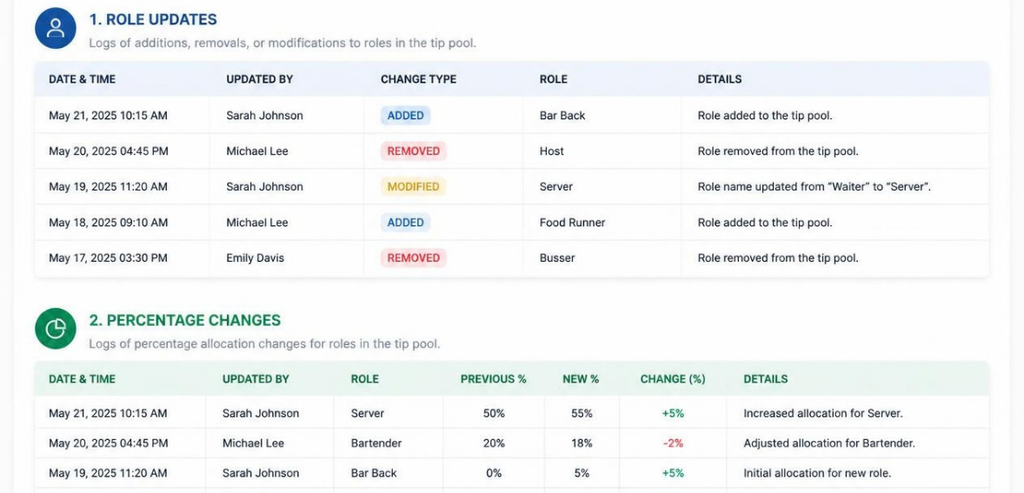
A tip pool change log is a running record of every adjustment you make to your tip pooling policy. Think of it as a diary for your pool. Each entry answers a few simple questions. What changed? Who approved it? When did it go live? And why did you make the change?
Most operators are good at recording tips, daily totals, and payouts. The aspect of the policy that they historically miss is split shifts, added or removed roles, or new states with new laws. Without a log, those changes are forgotten. A change log will stop those changes from evaporating. Good tip pool recordkeeping will create a defensible timeline if and when questions arise.
Why Tip Pool Recordkeeping Matters More Than Ever
Tip law is constantly evolving. Federal regulations under the Fair Labor Standards Act (FLSA) changed in 2018 and 2021. In December 2024, the DOL reinstated the dual jobs rule. Additionally, in January 2025, the DOL stated in an opinion letter that managers and supervisors are prohibited from receiving any portion of the mandatory tip pool, even if they perform the job of a bartender or waitstaff during the same shift. Operators who established their tip pools several years ago are using outdated regulations.
The cost of non-compliance is high. Violations require payment of back wages and a liquidated damages award equal to the back wages. For willful and repeated violations, the DOL assesses a civil monetary penalty of $2,515 for each violation. Further, their first item of business is to review documentation. In a tip pool enforcement action, inconsistency in documentation is one of the first obvious problems.
For this reason, maintaining records of a tip pool is no longer just a back-office task. Rather, it is a compliance necessity. A change log turns a vague policy into a dated, signed, documented one. For the current federal guidance, the U.S. Department of Labor updates its policy on its Wage and Hour Division tips page.
The Three Updates Your Change Log Must Capture
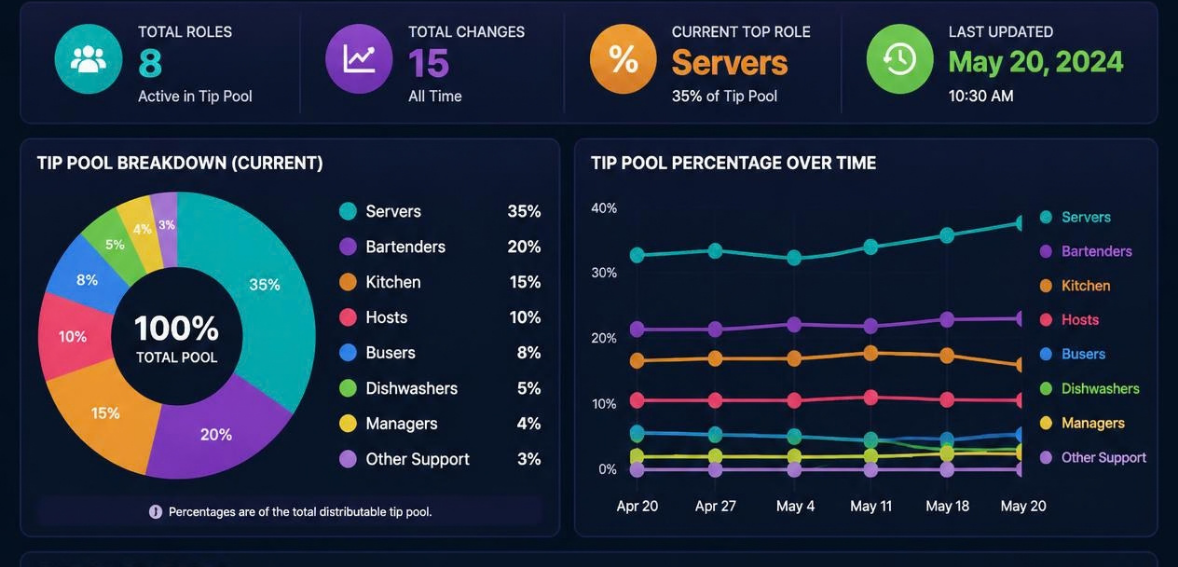
Not every change carries the same risk. But three types show up again and again, and each one deserves its own careful entry. These are the role, percentage, and effective-date updates that make or break a tip pool.
Role Changes
Changes in roles dictate membership in the pool. Most violations begin here. The FLSA prohibits employers, managers, and supervisors from retaining any portion of an employee’s tips. If an employee passes the executive duties test, then they cannot receive a portion of the tip pool, regardless of the amount of tipped duties performed during the shift.
The back-of-house staff adds more complications. Cooks and dishwashers can be a part of the tip pool only if the employer pays the full minimum wage and does not take a tip credit. If you take a tip credit and reduce the cash wage, the tip pool must be limited to the roles that are customarily tipped, such as servers, bartenders, and bussers. You should document each instance a position changes membership of the tip pool. You need to indicate the title of the position, the reason for the change, and whether a tip credit was taken. This one practice helps prevent the most common audit violation in the industry.
Percentage Changes
Percentage changes control how the money splits. Say your bar used to take twelve percent of the pool and you bump it to fifteen. That is a change your log must show. Record the old split, the new split, and the roles affected.
Percentages have a tendency to ‘drift’ over time. A manager may adjust a formula for a particular busy weekend and then forget to adjust it back. Six months later, no one even remembers what the “official” split was supposed to be. A change log eliminates this guesswork. It provides payroll a single source of truth and allows employees to verify their split. Adopting a transparent approach for the change log builds trust with employees and significantly reduces the occurrences of disputes that may eventually reach the DOL.
Effective-Date Updates
The effective date provides the answer to the most important question regarding any new rule: What is the date the rule goes into effect? A percentage split that changes on the first of the month means nothing if your payroll ran the old numbers for two more weeks. Two weeks of old numbers and timing mismatches are common complaints for wage violations.
Each log of a change needs an effective date, distinguished from the date the change was logged. It must also be clear when and how the communication was executed. Federal law requires notification to the employee and written notice for any change to a tip credit. If a tip credit change was communicated to the employee during the week of the change, then you comply. It is also best practice to have a signed acknowledgment of the change from the employee. It is an effective date to your policy, an effective date to the change in your systems, and an effective date to the change in your payroll.
How to Build an Audit-Ready Tip Pool Change Log
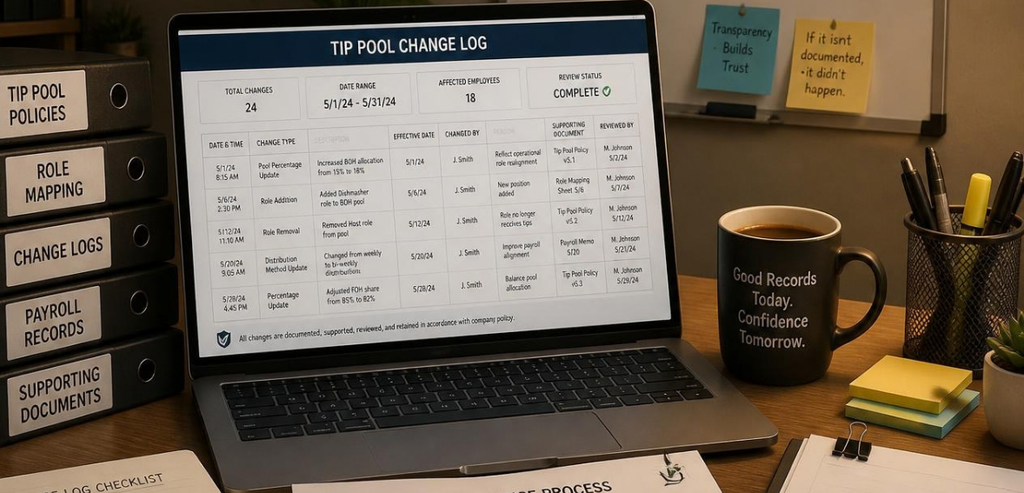
A useful log is detailed but not fussy. Each entry should capture the date you recorded the change, the effective date it went live, a plain description of what changed, the person who approved it, the roles or employee IDs affected, and the tip credit status at the time. Add a timestamp and a note about which rule set applied, and you have a record an investigator can follow in minutes rather than days.
Retention rules provide a clear-cut answer. The FLSA mandates that employers maintain payroll records for a minimum of three years. Records that serve as the basis for wage computations (e.g., time records and wage-rate tables) should be retained for a period of two years. For prudence, many operators retain everything for a period of three to four years, and some states require the retention of records for an even longer period. In instances of federal/state rule conflicts, the longer retention period shall apply. The DOL recordkeeping fact sheet provides the necessary details, and SHRM provides the payroll recordkeeping requirements for tipped employees.
When it comes to auditing, the retention of records is just as important as the detail. A retention log with only three entries communicates to the auditor that the system has failed. Retention logs with entries across every pay period communicate the opposite.
Tools That Make Tip Pool Recordkeeping Easier
Spreadsheets can work for a single location. They start to crack once you add multiple sites, shifting rates, and staff who cross roles. Purpose-built software fills that gap by baking the audit trail into daily operations.
Kickfin
Kickfin handles tip payouts digitally and records every manager edit in a detailed change log. That means each check-level adjustment leaves a timestamp and a clear reason behind it. For operators, this creates a ready-made audit trail and reinforces trust with staff, since everyone can see how a number was reached.
Netchex
Tip reporting is integrated into the payroll workflow at Netchex, so they do not have to add it later. Netchex tracks tip income at the employee level. Netchex’s payroll automatically performs tip credit calculations, runs minimum wage shortfall checks, and generates FICA tip credit documentation. Netchex automatically generates these reports, so the compliance team can quickly respond to DOL inquiries. The compliance team monitors changes to help operators stay compliant.
Your approach may differ, but the goal is the same. Capture the change. Record the time. Retain the record. Effective tip pool recordkeeping integrates into the payroll workflow. It alleviates stress during audits.
State Law Adds Another Layer
Federal law is only the floor. States build on top of it, and some go much further. California, for example, has long required that employees receive the full tip shown on a credit-card slip, and SB 648 reinforces that rule effective January 1, 2026. Florida raises its tipped minimum wage every September 30, which means multi-state chains must update payroll rates on a rolling schedule.
There is a tax-related issue to consider. In 2025, the One Big Beautiful Bill Act established a temporary federal deduction. This allows some employees to deduct up to $25,000 in qualifying tip income for the years 2025 to 2028, which is subject to income restrictions, in each of those years. Although it does not impact your pooling responsibilities, it increases the importance of proper recordkeeping for your tips. If you have multiple locations, view this as a requirement for each location. A change log to which jurisdiction each change applies to will keep you honest across states.
Common Mistakes That Trigger Audits
Almost every enforcement action has the same small multitude of errors. The most prominent is allowing a working manager or supervisor to be included in the pool. The next most serious mistake is to permit the inclusion of back-of-house staff in the pool while taking a tip credit. The rules do not permit this, and then there is the slow, methodical, losing error: inconsistent and/or missing documents. The policy states one thing, and records another.
Finally, a lot of operators do not amend their policy after a regulatory change and continue to use an old policy long after the old one has expired. A living change log protects against all of these, because it requires the organization to write down every decision as it is made.
Conclusion
Tip pooling is not the place to trust your memory. Rules shift, splits drift, and roles change hands faster than most policies get updated. A tip pool change log turns all that motion into a clean, dated record you can defend. It captures the three updates that matter most: role, percentage, and effective date, and it ties each one to a person, a reason, and a start date.
Start simple. Log the next change you make, note when it takes effect, and get a signature. Build the habit, keep your records for the full retention window, and layer in software as you grow. Do that, and the next time someone asks who was in the pool and when, you will have a straight answer instead of a guess. That is what strong tip pool recordkeeping is really for.
Frequently Asked Questions
Do I legally need a tip pool change log?
No single law names a “change log” by that title. But the FLSA does require you to keep payroll records for three years and to give tipped employees written notice of tip credit changes each week they occur. A change log is the cleanest way to meet those obligations and prove compliance during an audit.
How long should I keep tip pool records?
Keep payroll records for at least three years and wage-computation records for at least two years under the FLSA. Many operators hold everything for three to four years to stay safe. Check your state rules too, since some require longer retention. When in doubt, follow the longer requirement.
Can managers ever be part of a tip pool?
No. Managers, supervisors, and owners cannot keep any share of a mandatory tip pool, even when they perform tipped work like bartending. A 2025 DOL opinion letter reinforced this. Your change log should clearly document any role that moves out of the pool for this reason.
Can back-of-house staff join the tip pool?
Only if you pay the full minimum wage and take no tip credit. If you claim a tip credit to reduce cash wages, cooks and dishwashers must stay out of the pool. Note the tip credit status in every role change entry so the record is unambiguous.